
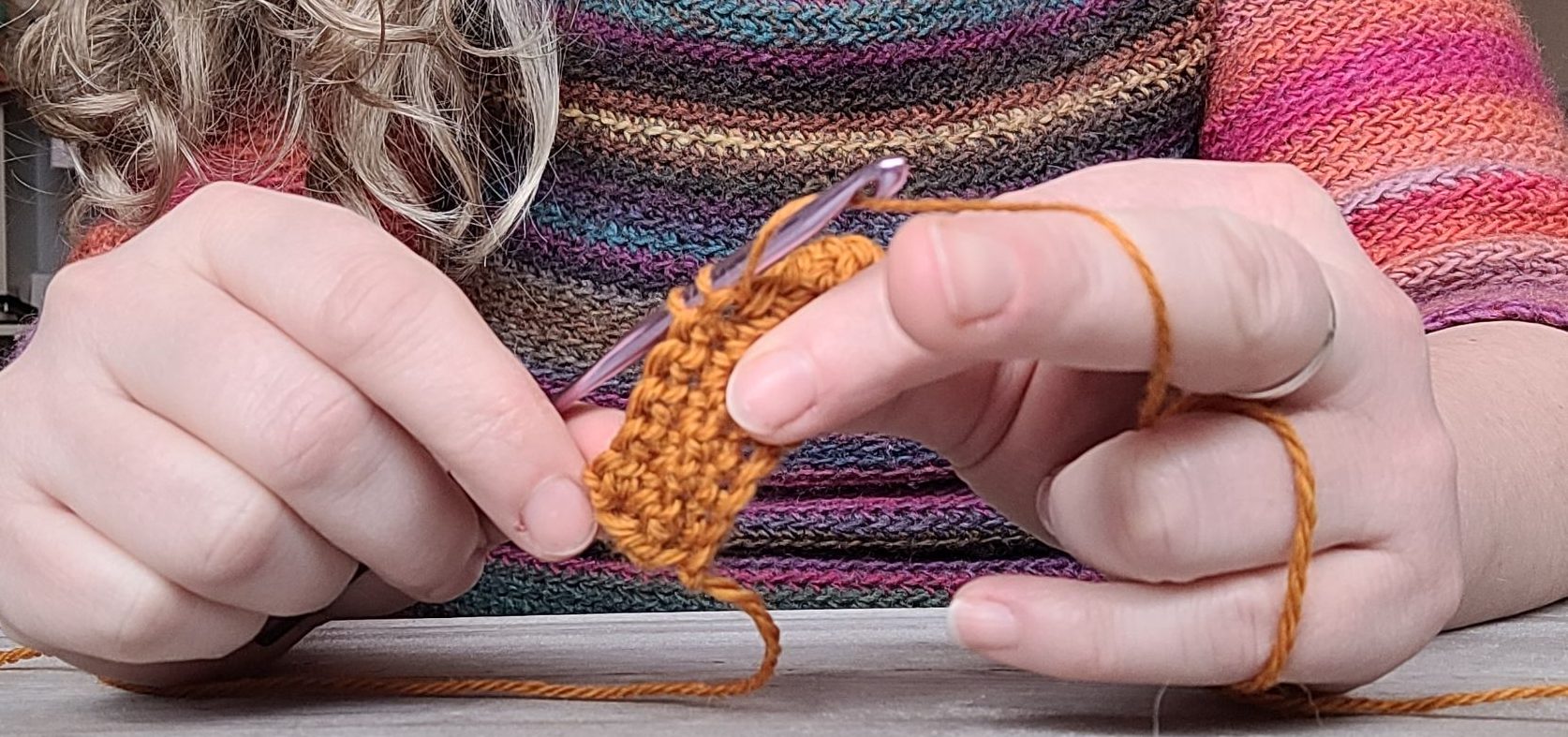
I’ve been teaching sundry traditional crafts classes for a good two decades now, and I pride myself on my patience, gentle encouragement and my ability to help struggling crafters improve at their own pace. I’m happy to repeat, I don’t show impatience, I centre joy and try to teach a love of the craft alongside the necessary skills to succeed.
In fact, up until I met this one student – let’s call her Mary – I actively described myself as a teacher who never left a student behind.
Thanks to Mary, I don’t make that claim anymore.
Now, before you judge me for making fun of a struggling student, hear me out. Stick with me. I promise it’s worth it.
Here’s how it went down.
Mary’s adult daughter contacted me, asking if her, her sister and their mother could book me for a family crochet class. I love working with related students. The dynamic is always brilliant. There are family jokes, a little teasing, well-worn stories to tell, and a comfort between people that you just don’t get at a table full of strangers, so I said yes, I’d love to.
They arrived at my studio, and for the first little while, all seemed normal. They were all beginners, so they all struggled with holding the hook, with managing their yarn, with making chains. But while the two sisters worked and progressed steadily, their mother didn’t.
Now, being as I never let a willing student flounder, I focussed on Mary.
Mary would wrap the yarn around the hook multiple times, and make a tangled, gnarling knot.
I’d remind her she only has to wrap it once.
After I undid the muddle and handed the hook and yarn back, Mary would wrap it multiple times again.
After we’d done that dance for a while, Mary would pull the loops off the hook without wrapping at all, yanking the yarn in the process, thus losing all her stitches.
I’d re-do the lost stitches so she had something to hold, I’d explain the single step I wanted her to take, then she’d do the same thing again.
Meanwhile, the sisters had their own questions, and understandably, they were getting annoyed with me for not managing my time between them all. They wanted to progress, to increase, decrease, figure out why their edges looked a bit wonky. All good, solid beginner stuff they had an absolute right to learn in a first class. But the fact was, every time I turned my eyes from Mary, I’d hear “Oh…”, turn back, and something new and tragic would have happened to her crochet.
Mary worried.
Mary blamed herself.
Mary’s daughters kept saying that she wasn’t good at this at all. Their impatience with their mother, and with me, was obvious.
I comforted and reset Mary over and over.
But despite using all my tricks, all my experience, every time I blinked, Mary made a mess.
There was simply no escaping Mary.
It was an hour and a half of this, folks. Ninety interminable minutes of “Not like that, Mary, like this,” “Do you remember what we said about the yarn over?”, “your hook needs to go in there, Mary.”
Now, I know some of you are thinking “Poor Mary sounds like she’s got a cognitive issue.” I thought the same. I’ve taught many elderly people over the years, I’ve taught quite a few of them with memory issues, with dexterity issues, with signs of dementia. Usually a carer tells me in advance so I’m prepared. Usually, a carer won’t be impatient to learn much themselves if the focus is on their charge. As far as I’m concerned, progress looks different for different people, and for people in mental decline, I see progress as them being present at a class; anything else is a bonus.
In this case, I got no volunteered info on Mary, so I soldiered on. I was all manner of patient, gentle, repetitive with Mary. If Mary wanted to learn, I was gonna teach her.
It wasn’t until the end of class – as they were leaving – that the sister who booked me said to me “I don’t think this is gonna work out.”
Reluctantly, I had to agree. I felt crest-fallen, though. I’d let them down. I’d taken three aspiring crocheters and in my care they’d chosen to quit. That broke my heart, it really did. I’d become the “bad teacher” I heard about so often from students who’d been told by less skilled tutors that they just didn’t have the talent to crochet. I hate the idea that someone would be dismissed like that, and yet, here I was admitting defeat with poor Mary.
Then I heard the other sister out at the car – in a very loud voice – tell her mother that she “PROBABLY SHOULD HAVE TURNED HER HEARING AID ON”.
Lads. Folks. Mesdames et Messieurs. My soul left earth for a moment while I digested this.
The sister who I was speaking to shrugged and told me. “She likes to save the battery”.
What the ever-living, actual fluff!
MARY HADN’T HEARD A SINGLE BLESSED WORD I’D SAID. And…aaaand. The daughters knew she wasn’t able to hear, either.
I could have cried.
But, I am nothing if not a crafting optimist. They may have learnt next to nothing from that ninety minute madness, but I can say for certain, I surely did.
I still promote myself as a teacher who never leaves a student behind, but I add an important caveat – MARY, TURN YOUR HEARING AID ON!


-

Bríd Shawl
€6.00
Discover more from Aoibhe Ni
Subscribe to get the latest posts sent to your email.
You survived this by at least knowing what the real issue was!
Have you ever tried to teach someone with long beautifully decorated fingernails? It got to the point that I would mention, “please don’t come with a new manicure but do bring your glasses” in the class description on how to prepare for a class. I never thought to mention to bring the hearing aid!
Thank you for sharing!
Roxann! 🤣 I can’t imagine how tricky it’d be to teach someone who had intentionally made it difficult to use their fingers! What on earth was your student thinking, I wonder?
I’ve had a few students that never “got” it. I came to understand that it wasn’t anyone’s fault – it just wasn’t for them.
People come to you (and me) for reasons that sometimes have nothing to do with learning to crochet.
Our ability to be kind and patient in the face of frustration (theirs and yours) makes an impact regardless of whether they continue to learn or not.
My job as a teacher is to teach, yes, but on a higher level, to be of service. I try to remember that always.
Whether the lesson was successful or not, you still made a difference. 💕
That’s a beautiful way to put it, Jeannie.
I think we both teach from the same place of love <3
Not trying to be rude; just trying to open up the scope of understanding humans.
Did u ever consider that ‘Mary’ had a learning disability or DEMENTIA?!
Oh, I absolutely did, and I go into detail about that in the story, too. If anything, that possibility is why I gave her my full well of patience and understanding throughout. It’s also why I changed her name and some key details in the story, too. Just in case.
But two things lead me to believe she wasn’t dealing with dementia or a learning difficulty. Firstly, in a class setting, usually a family member or carer will tell me in advance. It’s the kind thing to do for both me as a teacher, and for the student, too. That way we all go into the class with solid expectations and the student enjoys their time in class more because I know they’ll need extra guidance.
Secondly, the sisters were openly impatient with their mother’s pace of learning. I’ve had close family die of dementia-related illnesses. I understand how little use impatience is with someone in that condition. You simply have to let the repetition roll off you and allow difficulties the space they need to resolve.
Equally with learning difficulties. Patience is key.
Now, I’m perfectly willing to concede that the sisters may simply not be the “repetition rolling off you” kind of people. That’s totally valid. We all have our strengths and weaknesses. But the fact that they both knew their mother had her hearing aid off in class feels to me like the main issue.
It was definitely something they could easily have resolved for both Mary and me from the start, and dementia or no, she might have enjoyed the experience way more.
That all said, I really appreciate your comment and your defence of both Mary and people with dementia and learning difficulties in general. That kindness is good to see in the world.