
(A Note from Aoibhe: So, yesterday, I published a password-protected draft of this post for my family to read through and make changes on.
I didn’t realise doing that would send out a notification to all of you, too. Sorry for the confusion and in-box clutter!)
It’s hard, sometimes, to figure out if a trait that’s been passed from generation to generation is inherent in your DNA somehow, or if it’s just so baked into your up-bringing that it’s impossible to avoid.
And so it is for me, and my crafting brain.
It’s a rare hands-on activity that I won’t gleefully apply myself to.
Carpentry or baking, tree-pruning or yarn spinning, pottery or crochet; the actual particulars don’t seem to matter so much to me as the doing of it does. And maybe it’s innate. Maybe I was always going to be the type of person with a drawer full of fleece, and a life-long ambition to own a lathe.
Or maybe it’s something that has been passed down through so many generations of my family that I never stood a chance. Maybe learning wood-working from my Dad when I was barely old enough to hold a hammer did the trick, or maybe sewing on my Mam’s hand-crank Singer was the golden ticket, or maybe it was one of a million other moments where my aunt or my cousin or my Nanny taught me a skill that I’d file away for later use.
Early this summer, my family and I paid a visit to a small museum in Dublin. Number 14, Henrietta Street is a museum housed in, and entirely about, the history of the building itself.


The guided tour took us from the reception room, up multiple flights of stairs to an upper salon where we congregated. The group on this particular day included other people, but I’m going to focus on my own family. My Mam and Dad, my sister and her two kids, and myself. Three generations of our family, all handy people in one manner of another, had travelled to this museum for a very important reason. We were there to honour and acknowledge the skills of a fourth generation; my Great-Granny, Mary-Kate O’Sullivan (née O’Callaghan).
Number 14 Henrietta Street was built over 300 years ago, and initially, it was a high-class dwelling. Gorgeous plasterwork, high ceilings, windows that let in a glorious amount of light with enough floor space to allow for music rooms and withdrawing rooms and all sorts of fancy conceits.


The tapestry above was a highlight for me on the upper levels. I’m afraid to say I may have asked some questions about it that they weren’t prepared for, but bless our wonderful guide, she messaged the other guides, and live-reported their answers as they came in.
That’s how I can now confidently tell you that the tapestries you see here were dyed with woad and carmine. And possibly, cochineal and madder too. They were the other suggestions.


But as much as I wanted to linger on this tapestry, we were there for a reason, so we pressed on.
Down a level, and down another, we learnt how the entire street – which had started out so upscale and fancy – suffered a catastrophic economic downturn when the 1798 rebellion and the resulting parliamentary Act of Union drew all the big wigs away from Dublin, back to the British Empire’s heart in London.
All that finery and frippery meant little to the landlords who moved in, and over the decades and centuries all the up-scale trappings slumped into a tired truce with the poverty-stricken populace living there.


Finally, we were welcomed into the last room, a street-level apartment that had still been inhabited within most of our lifetimes. It had many familiar items, placed together in a way that felt like the occupant had just stepped out for a moment.
Her sewing machine lay idle, with a half-made pinafore on its stage.


Her table was set for guests, with tea made, and fresh bread and pie, ready for cutting.

Her chair by the window looked inviting, though I think our tour guide would have yelled if anyone had tried to sit on it. And on the wall of her bedroom hung newly-made dresses, and her home-made paper patterns.


But the thing we were actually there to see was this:

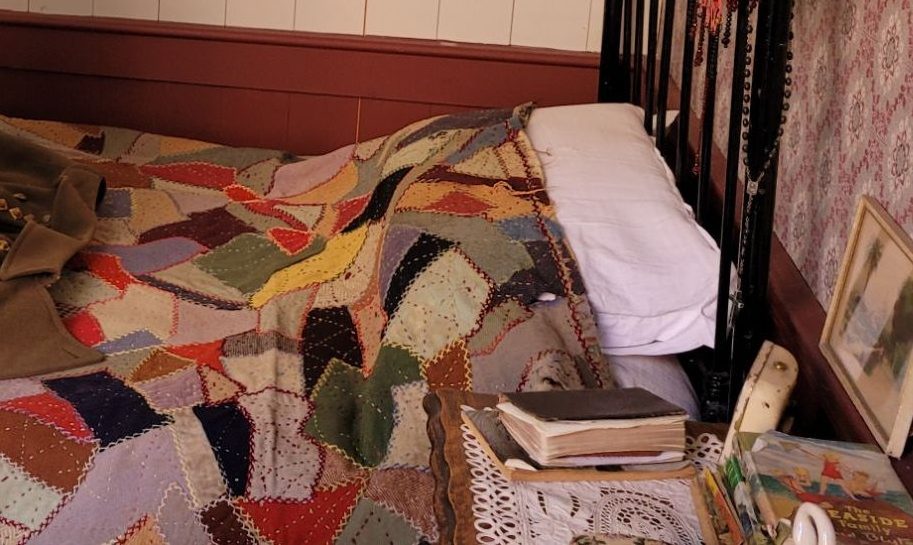
My Great-Granny, Mary-Kate’s hand-made patchwork blanket which now sits in pride of place on the museum’s old brass bed frame.
As a little girl, I played on this ancient crazy-paving appliqué quilt without realising the family treasure that existed under my bare feet. As a teen, I’d pull it out and set it up in the orchard grass on a nice warm day for a spot of sun-bathing, too.
Backed by rough-spun hessian and layered in scrap fabric from all manner of wool and corduroy off-cuts, “My Nanny’s blanket” as my Mam calls it was passed to her in Mary-Kate’s will and it remained with her until this very visit when she donated it – for posterity – to Henrietta Street.

The stitching is exquisite and tells of both the ingenuity of my ancestor and the need for such skills at the time, too.


Yes, there’s creativity and playfulness in it – no-one could possibly look at all those colours and all that stitching and not smile – but you can bet that this blanket was also an essential top layer during freezing winter nights.
It’s funny to think; little did Mary-Kate realise – as she was stitching and tying off her ends, and pinning on another patch – that her work of art would one day end up in a museum.
And little did she dream, I bet, that when it did, it would be surrounded by generation after generation after generation of family who take just as much pride in their creative work as she surely did in hers.

And what lesson did I take away from this day?
One thought has stayed with me since I last set my eyes on this blanket and carefully turned the edge up to peek at its neat and tidy underside; Be sure to keep the back of your own work neat, folks. You never know when something you made will end up in a museum!

Country Life – August
I don’t really ascribe to any one religion. But if I had to define my belief system it’d be one based on the slow turning of the seasons in Ireland. I find there’s always something new to marvel at; Maybe it’s getting darker in the evenings, or it’s bright ’til the crest of midnight, maybe…

Butterflies
If you’re anything like me, you haven’t touched your winter sweater pile since the end of moth season. And so now, at the dawn of autumn, and the promise of a good, honest, cold breeze, you might be thinking about taking that entire pile and dumping it in cold water with a little hand-washing soap…

Cross Stitch Direction Guide
A Note from Aoibhe Ni:This tutorial has been created to specifically accompany my Multi-Crafts course on cpdcollege.comIf you are a Primary School Teacher in Ireland, and are looking for a series of fun, mid-summer courses for next year, drop on over. I have two craft courses available so far (a crochet course, and a multi-craft…

My Own Personal Sunshine
My Own Personal Sunshine
It’s a strange time to be a designer. Very recently, I discovered that an annual job I had expected to be renewed wasn’t going ahead as usual.

Free Tunisian Crochet and Traditional Crochet Shamrock Patterns
Tunisian Crochet and Traditional Crochet Shamrock Patterns
Chances are, wherever you are in the world, this coming weekend, you’re likely to encounter at least a couple of Irish people.
Aoibhe’s Most “Patch-work” Patterns
-

Anansi
€6.00 -

Bríd Shawl
€6.00 -

Finola
€5.50 -

Homeward Bound
€5.00 -

King Lir Shawl
€7.00 -

Pick A Lane Sweater
€7.50 -

Selkie
€5.00 -

Venus Shawl
€6.00