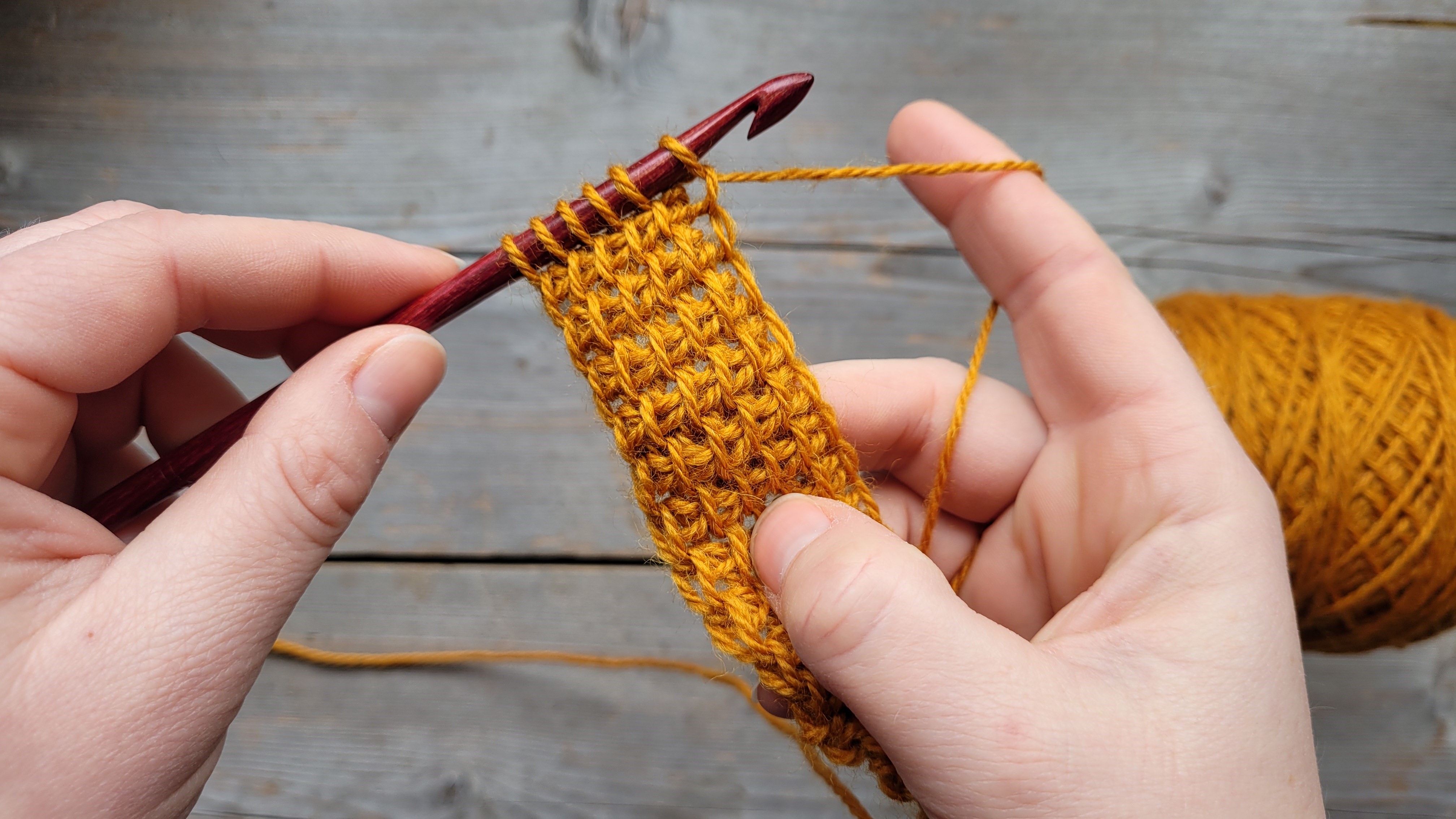
Here’s where we’re starting: a nice piece of UK dc/US sc on the round.
This technique works best on the round, as all the V’s on your working edge are facing the same direction.
UK dc / US sc on the round
To being your bind off, cut yarn, then increase the size of the loop on your hook until the end pops through and the loop is gone.
pull
p-u-u-u-u-ll!
there we go!
Thread the end onto a bodkin or a blunt-ended needle.
Then, sew underneath the two “arms” of the V on top of the next stitch along. Be sure that only those two strands of yarn are isolated. The rest of the stitch is to be left untouched.
Bodkin threaded
Bodkin worked under both “arms” of the next V along
Pull bodkin through fabric, and then tighten strand of yarn so it matches the tension of the stitches around it.
Bodkin pulled through fabric
Strand tension achieved
Then, take tip of bodkin, and press it the centre of the last stitch you crocheted. It will be the same spot that the strand you’re working with is sprouting out of. Again, pull the strand tighter
Bodkin pressed into centre of last crochet stitch made
Strand being pulled tighter
A little tighter
Just right!
Weave your end into the fabric a little bit to secure your end, and there you have it! Your completely invisible bind off!
Here’s where we’re starting: a nice sheet of stocking stitch on 4.5 mm knitting needles.
We’re going to use a 4.5 mm crochet hook to cast these stitches off.
Ideally, your hook should be around the same size as your needles. A little smaller can also work, for a neater edge, but try to avoid going much bigger; the edge will tend to frill (unless that’s what you want, in which case, go for it!)
Knitted Stocking Stitch Fabric
4.5mm needle and 4.5 mm hook, ready to cast off
Insert hook, knitwise into first stitch.
Slip first stitch off needle and hold on hook.
hook into first stitch
first stitch slipped onto hook
Insert hook into next stitch on needle.
Draw yarn between hook and needle, travelling OVER the hook, between the needle and hook, then UNDER the hook. (Knitters: This Yran Over is worked in the opposite direction to the way many of you usually work, so take note of that as you go).
hook inserted knitwise into next stitch along
Yarn Over passes between hook and needle
Using hook, draw Yarn Over through closest loop to hook head. Then push the stitch that’s still on the needle off it. You now have two loops on your hook.
Yarn Over hook (same direction as before)
two loops on hook
Yarn Over in place
Draw Yarn Over through both loops on hook.
You are left with one loop on your hook and your first knit stitch cast off.
Begin casting off next stitch on needle by inserting hook knitwise.
One loop on hook, first knit stitch cast off
hook inserted into next knitting stitch
From here, we’re repating the cast off process from the first Yarn Over.
Yarn Over BETWEEN hook and needle
Yarn Over drawn through knitting stitch. Stitch slipped off needle
second Yarn Over
Yarn Over drawn through both loops
That’s your second stitch cast off.
When you repeat this for a while, you’ll start to see your crochet stitches build up behind your hook like this:
half of the row cast off
Okay, now.
To cast off your cast off row, work until you only have one loop on your hook and your needle has no stitches left.
Then, Yarn Over…
final loop of cast off row
Yarn Over added to hook
Break yarn, and dra-a-a-a-aw end through loop…
end drawn through loop…
loop getting b igger and tail getting smaller
…until it pops through.
Then, pull end to tighten the little knot in the corner of your fabric.
end pulled through to secure last stitch
pulling the end will tighten that last stitch and turn it into a little knot
And that’s your fabric totally bound off!
Don’t forget to weave in your ends, though!
return pass complete. close-up of site of INC1 increase
Here’s where we’re starting: a nice sheet of TSS stitches.
We’re going to put a INC 1 increase in the middle of the next row which will increase our stitch number by one stitch.
Tunisian Simple Stitch fabric
work TSS sts up to the spot you intend to increase
To increase, wrap yarn over hook.
Then, with Yarn Over still in place, work hook into next line/stitch along, yarn over and draw one loop through line/stitch.
The INC1 Yarn Over is still on the hook and locked between two regular, TSS stitches.
yarn over
next TSS complete
Finish the rest of the forward pass as usual.
Once forward pass is complete, work return pass as usual, i.e. YO, draw through 1 loop, then *YO, draw through two loops* repeatedly until only one loop remains on hook.
For next row, work up to INC1 yarn over as usual…
Return pass complete. INC1 Yarn over visible in centre of fabric.
Next Forward Pass started. Hook worked up to INC1 Yarn Over of previous row.
… then you have a choice.
Either
A) Work hook into INC1 yarn over itself, or…
B) Work hook into eyelet made underneath INC1 yarn over.
A) Hook worked into INC1 Yarn Over
Yarn Over added to hook
Yarn Over drawn though INC1 Yarn Over
B) Eyelet identified
Hook into eyelet
Yarn Over added, and drawn back to front of work
Either choice is valid.
Then, complete Forward and Return Passes as usual.
After a few rows back and forth, this is the type of texture you’ll get in your fabric:
When my Mam taught me to crochet, she did so by handing me a Granny Square blanket she was working on, and teaching me to treble crochet clusters into her already beautifully crocheted fabric.
I focussed on the stitches, on how they danced around my hook, and how the fabric grew under my fingers as I crocheted towards the corner. Then she showed me how to add enough stitches to veer around it and start on the next straight side.
Because I didn’t have to struggle with magic loops or counting or seams, I was able to learn to love the craft from the moment I began, and it’s that reason I think this modified “one block” granny square pattern makes for the perfect pattern to introduce a new-comer to the craft.
Now, bare in mind crocheters, YOU will have to make the first 4 rows for your prospective crochet genius before you hand it over, but once you do, the rules simplify to a point where a beginner, even with very little crafting experience, can pick up the rhythm and crochet confidently.
Starting your gorgeous Granny Square
Note: This pattern is written using UK stitch terminology.
Make 6 chain stitches, 1 slip stitch into chain furthest from hook to make a loop.
6 chain stitches
make into a loop with one slip stitch
Round 1. Into the loop, make 1 dc, 1 htr, 14 tr.
double crochet and half treble on 6-chain loop
14 treble crochet stitches added to loop
Note: This Granny Square has NO seams at the start or end of a round. In fact, because it’s worked in an ever-increasing spiral, there technically is no start or end of a round. As my Mam says, you simply crochet this square until you either run out of yarn or run out of patience – whichever comes first.
Round 2.
Into the gap between htr and 1st tr, make [3 tr].
the gap between the half treble and the first treble crochet stitch
3 treble crochet stitches in the gap
*sk 2 sts, work [3 tr] into next gap*, 6 times. (This gives you 8 clusters, each with 3 trebles in them and 8 “gaps” between them.)
3-treble clusters all around the edge, separated by 2 trebles each on previous round
Round 3.
*Into next gap, make [6 tr], into next gap make [3 tr]
the next gap is the big one to the left of your hook
6 trebles crochet stitches in the gap outlined in previous image, and 3 treble crochet stitches int he next gap along
Repeat the above, 3 times.
Note: The 6-tr clusters are your corners, the 3-tr clusters make up the sides of your square.
4 corner clusters (6 trebles each) and 4 sides (made of a 3-treble cluster each) completed
Does it look a little wonky and warped? Sure! It’s a spiral with corners after all, so it’s always going to be a little off-kilter. (Who among us isn’t a little wonky, though, right?)
But as I said in the intro, this is a great pattern to teach someone to make Granny Squares. It’s not an award winning masterpiece; it’s a starter kit.
Round 4.
Into middle of next 6-tr cluster make [6 tr], *into next gap make [3 tr]* twice.
One corner (6 trebles) and one side (2 sets of 3 trebles) complete.
Repeat for other the corners and three sides.
Your square is ready to hand over to your crochet student. (Or maybe use it to start a One-Square Granny blanket of your own. They can have the next square you start! 😉
At this point, your Granny Square should have four identifiable corners, and enough gaps between clusters that your beginner has space to learn and practice.
After this, it’s simply a matter of remembering the two basic rules of Granny Square manufacture:
When you encounter a gap, put three trebles in it.
When you see a corner, split it in two and add 6 trebles in the middle.
Granny Squares are just pure, logical genius. So, if you follow those rules, your One Square Granny will be a success.
Once your beginner has a little practice, and muscle memory has started to develop, you can add chains between the clusters, or teach them a more complex square pattern with seamed rows, or multiple colours. But I guarantee you, this will remain a favourite thanks to its simplicity, its gorgeous texture and the fact that, with a little experience, you can carry on crocheting while watching TV and not miss a stitch!
Folks, I’m happy for you to use this pattern to teach classes and individuals. All I ask is that if you get paid for teaching this using pattern, that you refer back to this page and link your students to it and my work.
Tunisian Crochet seams can often look botched and ugly.
Here’s how to make your Tunisian Crochet garments and accessories look seamless!
Start With Some Tunisian Crochet
In this case, I have made a lovely piece of Tunisian Simple Stitch which I’m going to seam along the first and last rows.
Keep the last row you made closest to you, with the Right Side facing outwards.
Setting Up the Seam
The first thing we’re going to do, is add a little slip stitch to the two corners of our seam. This will ensure the edge of our work is smooth.
Find the V on the edge of your FIRST row and add a slip stitch to it.
2. Insert finger between sides to help control your work.
Now, we can get to the real seaming business:
This seam is made by “zipping” one side of your fabric to the other. We will be pulling each bar/line on the LAST row through each bar/line on the First row, and securing it there with a UK dc / US sc.
Here’s how:
Locate the nearest line/bar on the FIRST row
2. Insert hook into it
3. Locate the nearest line/bar on the LAST row
4. Insert hook into it
5. Secure LAST row loop with hook and…
6. Draw LAST row loop through FIRST row loop
First ‘zip’ complete
Time for a little traditional crochet!
* This seam won’t hold without a little help, so we’re going to add a UK dc / US sc st onto the loop left on the hook. Let’s do it!
1. Yarn Over.
2. Draw Yarn Over through one loop
3. Yarn Over again.
4. Draw Yarn Over through both loops
Repeat the “zip and secure” sequence for each pair of bars/lines on your seam until you get to the end.
It will look like this at this stage.
The inside of a completed (Almost) Invisible Seam.
There’s just one final thing to do; slip stitch into the two corners to smooth out the edge.
Here’s how:
1. Insert hook into both corners.
2. Yarn Over.
3. Draw Yarn Over through everything else on hook.
Bind off. Weave in ends. You know the drill.
Then, when you flip your fabric the right way out, you notice your seam is (almost) invisible, nice and strong and flexible!
A completed (Almost) Invisible Seam
SIDE NOTE: You may ask, “Hey, Aoibhe, why not use a slip stitch throughout the seam? Surely that’d take less time, use less yarn and sit flush with the fabric, right?”
And I’d say, yes, it would. Technically.
But also, slip stitches have zero stretch and zero chill.
Tunisian fabric has a lovely level of 4-way stretch, and if you add a non-stretchy seam to one part, it’s bound to cause shaping, comfort and blocking issues.
So, while a double crochet is, indeed, a little bigger, uses a little more yarn and takes more time to do, it’s still a better choice over all.
Tunisian Crochet seams can often look botched and ugly.
Here’s how to make your Tunisian Crochet garments and accessories look seamless!
Start With Some Tunisian Crochet
In this case, I have made a lovely piece of Tunisian Simple Stitch which I’m going to seam along the first and last rows.
Right Side in, Wrong Side out. Last Row furthest away from you.
Setting Up the Seam
The first thing we’re going to do, is add a little slip stitch to the two corners of our seam. This will ensure the edge of our work is smooth.
Find the V on the edge of your FIRST row.
2. Insert hook, from front to back, into it.
3. Yarn Over
4. Draw the Yarn Over through work and through loop on hook.
Now, we can get to the real seaming business:
This seam is made by “zipping” one side of your fabric to the other. We will be pulling each bar/line on the LAST row through each bar/line on the First row, and securing it there with a UK dc / US sc.
Here’s how:
Locate the nearest line/bar on the FIRST row
2. Insert hook into it
3. Locate the nearest line/bar on the LAST row
4. Insert hook into it
5. In order, from left to right: LAST row loop, FIRST row loop, loop that was already on the hook.
6. Draw LAST row loop through FIRST row loop
First ‘zip’ complete
Time for a little traditional crochet!
* This seam won’t hold without a little help, so we’re going to add a UK dc / US sc st onto the loop left on the hook. Let’s do it!
1. Yarn Over.
2. Draw Yarn Over through one loop
3. Yarn Over again.
4. Draw Yarn Over through both loops
Repeat the “zip and secure” sequence for each pair of bars/lines on your seam until you get to the end.
It will look like this at this stage.
A completed (Almost) Invisible Seam
There’s just one final thing to do; slip stitch into the two corners to smooth out the edge.
Here’s how:
1. Insert hook into both corners.
2. Yarn Over.
3. Draw Yarn Over through everything else on hook.
Bind off. Weave in ends. You know the drill.
Then, when you flip your fabric the right way out, you notice your seam is (almost) invisible, nice and strong and flexible!
A completed (Almost) Invisible Seam
SIDE NOTE: You may ask, “Hey, Aoibhe, why not use a slip stitch throughout the seam? Surely that’d take less time, use less yarn and sit flush with the fabric, right?”
And I’d say, yes, it would. But also, slip stitches have zero stretch and zero chill.
Tunisian fabric has a lovely level of 4-way stretch, and if you add a non-stretchy seam to one part, it’s bound to cause shaping, comfort and blocking issues.
So, while a double crochet is, indeed, a little bigger, uses a little more yarn and takes more time to do, it’s still a better choice over all.
How to increase the height of your Tunisian Crochet column, without leaving a hole in your fabric.
This is so quick to do. You’ll love it.
Start With Some Tunisian Crochet
In this case, I have a layer of crochet done, and have started into a second layer. The layer I’m working on is three bars high.
If you want to do the same, go ahead, I can wait. It’s no bother. I can just go make a cup of tea.
A layer of linked stitches.
Work the Downward Pass
Pick up loops in all the bars, as you have done for every column of the row so far. Don’t work into the next base just yet. We’ll get to that in a second.
Do you see the hole at the base of your PREVIOUS column? Work your hook into it.
Loops picked up. Hole at base of previous column visible to the left of thumb.
2. Hook into hole at base of previous column.
Yarn Over, and draw a loop through fabric.
This adds a loop to hook that wouldn’t have been there otherwise (an increase)
Yarn Over
2. Extra Loop
Now, we continue the Downward Pass by working hook into NEXT base:
Hook worked into NEXT base along.
Yarn Over, and draw a loop through to front of fabric:
Yarn Over
2. Pull through
Work Tunisian Crochet Upward Pass as usual
* Yarn Over, pull through two loops * repeatedly until one loop is left on hook.
The three bars are now accompanied by a fourth (at the bottom of the column).
You are now working with four bars where before, you only had three.
Here’s what a completed, taller layer will look like.
A three-bar layer has been transformed into a four-bar layer. Lovely job!
You have your first row of stitches complete, but now it’s time to start into the second row, and suddenly, everything looks different.
Here’s how you do it.
The Lay Of The Land.
Let’s look at what we’ve got.
In this instance, we have made 8 chains and skipped the one closest to the hook. Then, we used the other seven chains to make double crochet stitches. So far, so shiny.
a V-shape sits on top of every crochet stitch. Use them to count.
Make a turning chain
A ‘turning chain’ is just a regular chain stitch (Like the 8 chains we did at very the beginning). The only reason it has a different name is because it serves a different purpose.
In this case, it adds a little extra yarn to the edge of our fabric so that the edge won’t be tight and inelastic when we’re done.
Here’s how a chain is done:
Yarn Over
2. Pull ‘Yarn Over’ through loop on hook to complete ‘Turning Chain’.
Now, turn your work.
Orientation is key here. When your turn is done properly, your tail should be at the bottom of your work, your hook should be at the top (On the right for right-handed people and on the left for left-handed people)
Hook at the top and tail (under right thumb) at the bottom.
Now it’s time to find your V’s
There is a V-shape on top of every stitch, but right now, they’re on the side of your fabric facing away from you. Turn your work so that you’re able to see the top. You’ll to find your V’s there.
The 7 V-shapes we had originally have been joined by an eighth. The V closest to your hook is the one belonging to the ‘turning chain’.
Skip over the ‘turning chain’, and find the next V along.
That’s where we’re going to put our first double crochet of this row.
It’s just a case of using the same dance steps we did on the first row to make a double crochet.
Yarn Over
2. Pull ‘Yarn Over’ through to front of fabric.
3. Second Yarn Over
4. Pull ‘Yarn Over’ through BOTH of the loops on the hook. When you are back to one loop, the stitch is complete.
To begin our second stitch of this row, we need to look at the fabric we’ve made so far.
Under the double crochet we just completed, there is a hole. I have an arrow indicating its location in the next photo.
The hole tells you where you have already been.
This hole was made by your crochet hook when you created the last stitch. It tells you that you have already been in that section of fabric. So, when it’s time to insert your hook for double crochet number two, move to the left one space.
Hook inserted into SECOND stitch space, ready to make second double crochet
The second double crochet is created the same as the first. See photos below for a recap.
Yarn Over
2. Pull ‘Yarn Over’ through to front of fabric.
3. Second Yarn Over
4. Pull the ‘Yarn Over’ through BOTH of the loops on the hook. When you are back to one loop, the stitch is complete.
Rather, Rinse, Repeat.
Every double crochet stitch you make on this and every other row will be created like the one above.
When the row is done, you should have something that looks a little like the image below.
Gorgeous!
Note: When you being a new row, don’t forget your ‘turning chain’!
Have you ever considered the tension your yarn is under once it’s been wound into a cake or ball? One of the main reasons yarn is sold in a skein is to preserve its elasticity. So, from the second you wind it, it’s being held at a stretch.
Animal fibres in particular have a gorgeous spring to them. If you stretch them, they snap back on release. This elasticity gives a finished garment a bounce and a wearability that is a pleasure to behold.
But if these fibres are held at their limit for too long, they can lose that elasticity entirely. That’s why you should only wind your skeins when you intend to knit or crochet with them soon after. It’s also why those old balls of donated yarn tend to seem so lifeless – they’ve been held at a stretch for decades. Yikes.
Ball winders and swifts are an amazing piece of kit I believe every crafter should invest in, but there’s a pull between swift and winder, so even they can add tension to a newly-wound skein.
They’re actually the exact same skein. The one on the left has been wound directly from the skein on my swift. The one of the right is the same ball, wound from the first cake into a second, much more relaxed cake.
Look at the size difference! And imagine the tension the first one would have been under had I only wound it once.
Same exact skein of yarn, first wind (left) second wind (right)
So, tell me. Are you kind to your yarn? Do you ever rewind?
And if you haven’t done it before now, have I convinced you to start? I sure hope so! And I bet your yarn will thank you, too!
Oh! And… psst! The yarn I’ve pictured here is a beautiful skein of Ballyhoura Fibre yarn. It’s Cierra’s 4-ply sock in colourway “Pot Pourri”. Watch out for it in a pattern this autumn! You can find the link here: https://www.ballyhourafibres.com/