Posted on 3 Comments

How do I stop Tunisian Crochet from CURLING?

a small piece of light green tunisian crochet held close to the camera. the fabric is curling into a tight spiral.

Oh my gosh, the CURL! It’s the bane of a Tunisian Crocheter’s day, isn’t it?
Curing the curl seems almost impossible, but never fear! I’m here to help.

I’ve gathered up a few of my favourite solutions to this perennial problem.
Let’s get right into it!

Firstly, WHY does Tunisian Crochet curl as enthusiastically as an overly-amorous octopus?

It’s all to do with the way Tunisian is constructed.

Much like stocking stitch in knitting, most of the yarn in a row of Tunisian Crochet is concentrated to the wrong side of the fabric – essentially, there’s lots of pressure on the back of a piece of Tunisian and the front hasn’t got the strength to push against it, so the fabric curls forward.

This is more noticable in some stitches – Tunisian Knit Stitch is a particularly emphatic curler – but there are ways to lessen this tendency, and methods you can employ from the very start of a project to help you avoid the dreaded curl.

1. Choose your hook wisely.

Since the problem lies in the density of the yarn on the back of your fabric, a good solution is to help it relax by loosening the fabric all over. The simplest way to do that is to go up a hook size or two.

two pieces of light green tunisian crochet on a faded wooden surface. The fabric on the right is tightly curled, the fabric on the left has a relaxed curl. Both pieces are still attached to crochet hooks
The fabric on the left was made with a 6 mm hook. The fabric on the right was made with a 4.5 mm hook.


If you’re a crocheter who’s new to Tunisian, you may be thinking: “Won’t that result in a project full of holes?!”
Luckily, the answer is “No”.

Think of Tunisian as a knit fabric made with a crochet hook. Knitting is more forgiving than crochet when it comes to changing needle size and thankfully, Tunisian shares this trait.

So going up a few hook sizes will give your Tunisian a chance to relax and the curl will all but disappear. Remember, though, this will also result in a BIGGER finished object, so if you’re following a pattern, be sure to pay close attention to the tension info first and foremost.


Check these projects out.
They all use lace-weight or fingering weight yarn, and a 5 mm hook or larger.

2. Make a tube.

Choose a project that solves the problem by seaming the first and last rows together. You can use any seaming technique you prefer for this. The very act of sticking the first and last rows together means the curl is totally eliminated.

a small piece of green tunisian crochet that it part-way seamed into a tube. The edges of the unseamed half are curling outwards.
By seaming the first and last row the curl can be eliminated completely.


After all, if your fabric is made into a tube, there’s nowhere for the curl to curl to, right?


These patterns all feature seams that stop the curl.

3. “Block” your project.

“If you want Tunisian to stay flat, block it til it squeaks!” a friend of mine once said, and while I agree with that in theory, I try to be a little more gentle with my own projects.

“Blocking” involves submerging your project in cold water until it’s fully saturated before removing it, gently rolling it up in a towel and pressing the water out of it. (I like to roll my shawls up in a giant beach towel before standing on them barefoot. It’s a moment full of triumph for me, like standing on the peak of a mountain!)

a small piece of green crochet is pinned to a black foam surface with white topped pins. a hand on the left steadies the mat while a hand on the right inserts the final pin.
Much like the washing instruction that says to “lay flat to dry, reshape while damp”, blocking allows some measure of control over the final shape you get from your crochet.


Then, the damp project is laid out to dry using a blocking mat (a yoga mat, a child’s giant foam jigsaw, or a handy spare mattress strewn with towels are all good alternatives) and pinned in place to dry. Once dry, the fabric will retain the shape is was pinned in, so if it was pinned flat, it’ll stay flat.

Bear in mind, this technique won’t work as efficiently with acrylic/acrylic blend yarns as they don’t relax in water in the same manner. Similarly, anything particularly high in soft and fluffy fibres, like angora or cashmere, will appear to block well – even after you remove the pins – but after a short time will relax back to its original shape.

It’s best to keep those fibres for projects that don’t need blocking to look their best.


Tunisian Lace benefits particularly from being blocked.
These patterns all feature lace eyelets that pop after blocking!

4. Learn to love the curl.

Tunisian crochet is a beautiful and versatile craft, and like its cousins – crochet and knitting – there are many things it does extremely well.

If you reframe its tendency to curl into an advantage, you may be able to include it in your next project as a positive feature.
How about a rolled sleeve on your next sweater?
Or a thick cozy brim on a wooly winter hat?
You could make yourself a crochet hook holder that’s just dying to roll up and protect all your precious tools from the elements!

Or how about this cheery little tea cozy with a gorgeous curly bottom?

a one-cup teapot sits in a white wooden surface. It has a peach/pink Tunisian Crochet tea cozy on it that is gathered at the top and rolled at the bottom.
As Easy as A… B… Tea!

No fabric characteristic is ever entirely negative – it’s all about what you do with it – so if your project would benefit from a cheery curl, why go to the trouble to getting rid of it at all?

Did you enjoy this tutorial? Tell me in the comments below!
And hey, tell your friends too!


— ALSO ON THE BLOG —

Posted on 3 Comments

Herringbone seam for Tunisian Crochet


Creating a truly invisible seam in any form of crochet has so far proven virtually impossible.

Some come close. I like to think my “Infinity stitch” has helped crocheters hide their selvedge seams better over the years.

But in general, the complex texure of crochet fabric doesn’t lend itself to easy, handsewn immitation, so instead I like to throw subtlety to the wind and celebrate my seams by making a feature out of them.

This seaming technique is one of my favourites because it’s stretchy, it follows any colour shifts in your yarn, and it requires less than 6 inches of extra yarn, no matter how long the seam needs to be – so if your yardage is running low, you needn’t worry too much.

I’ve named it the “Herringbone Seam” because the modified slip stitch I use gives a lovely fishbone texture to the resulting join.

Let’s get right into it!
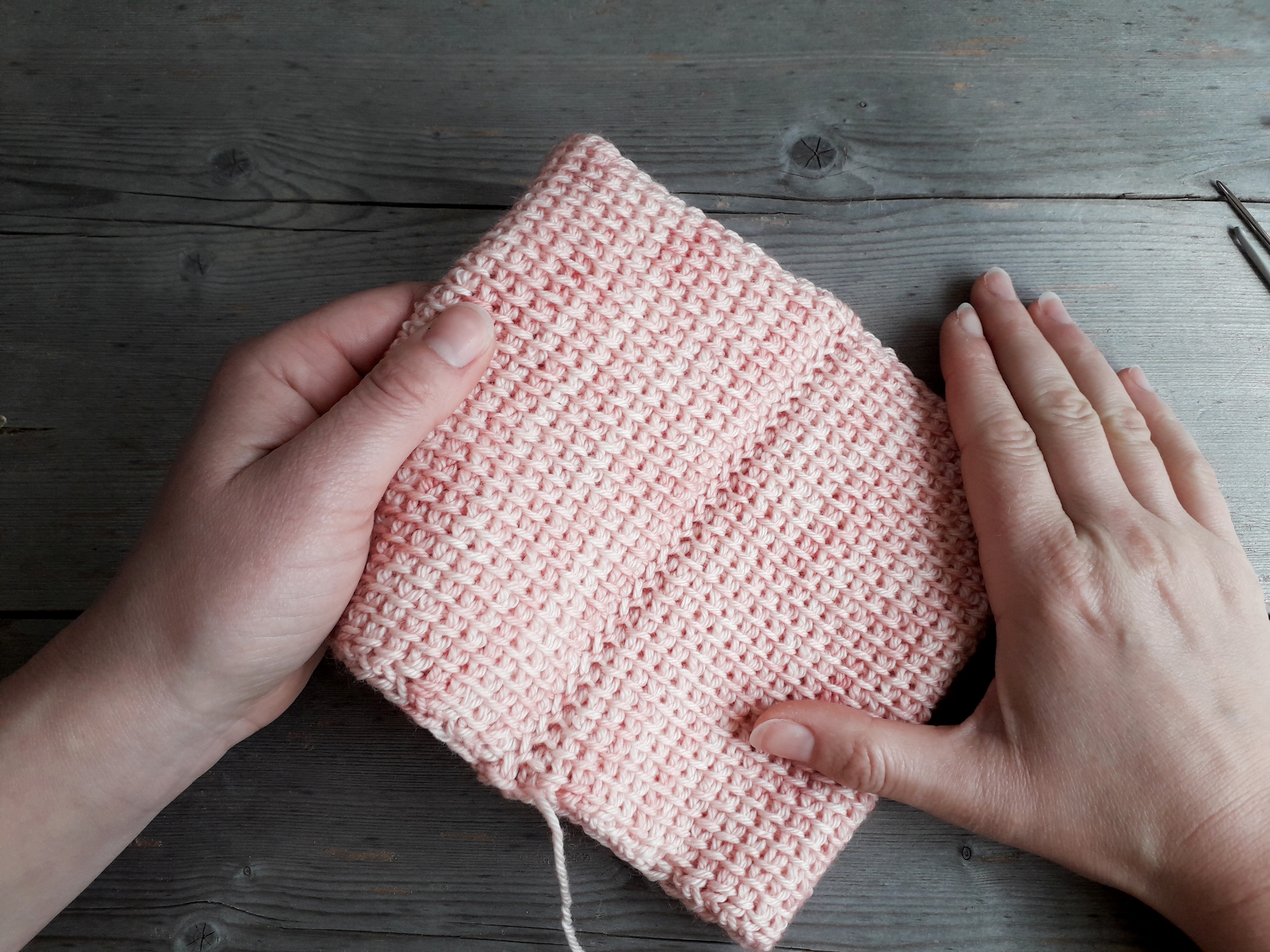
This is the piece of Tunisian Crochet I’ll be using for this tutorial. It’s a sheet of Tunisian Simple Stitch (TSS) and I’ll be seaming the first row to the last row to make a cylinder.

Yarn by Ginger Twist Studios:
Pep In Your Step Worsted – Colourway: “Millions of Peaches”

We first need to prepare the fabric for seaming.
Run a row of UK dc/ US sc sts along the top of the last row of TSS sts.
Note: For the rest of this tutorial, I’ll refer to this st as a “double crochet” or a “dc”.

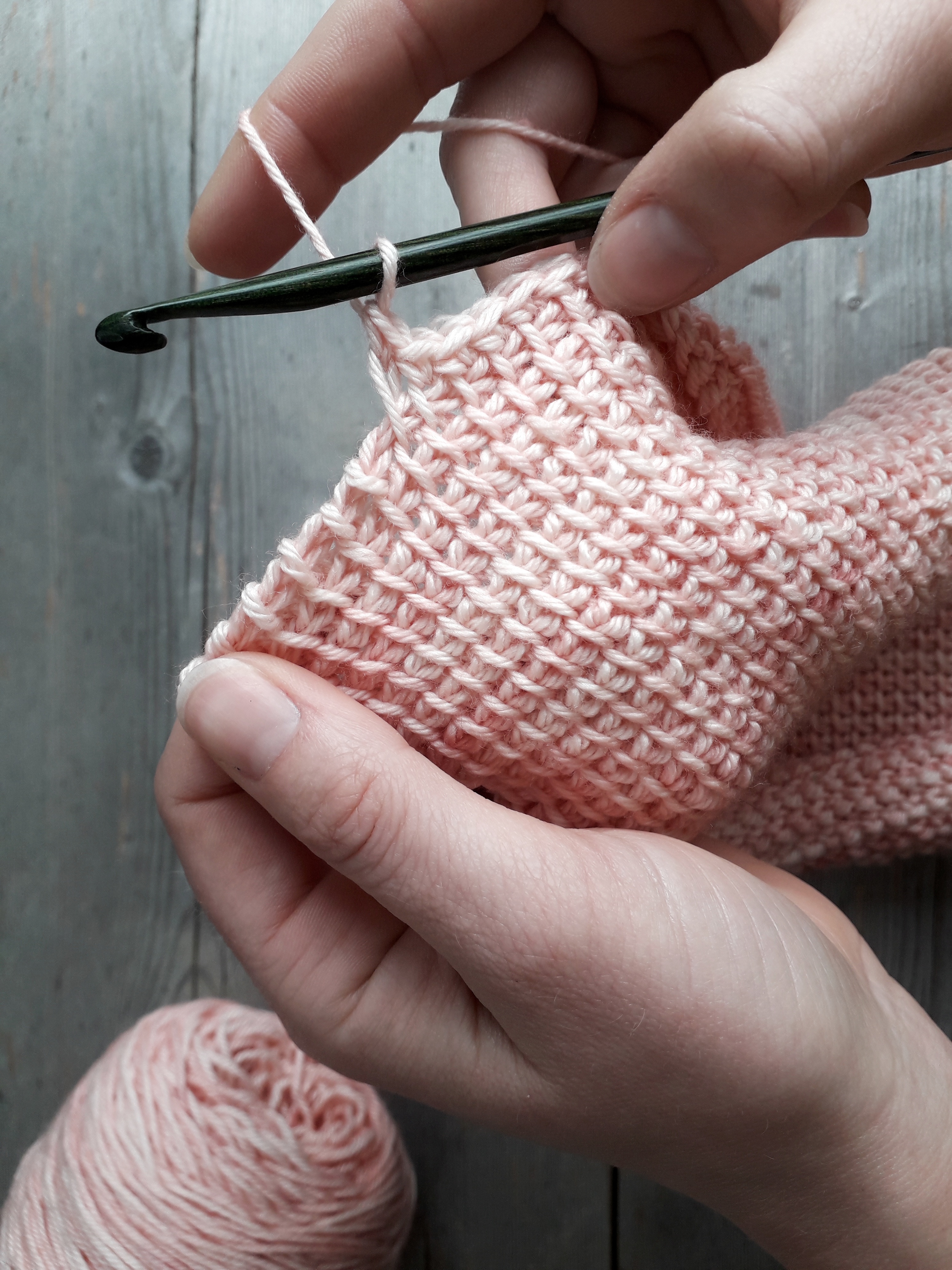
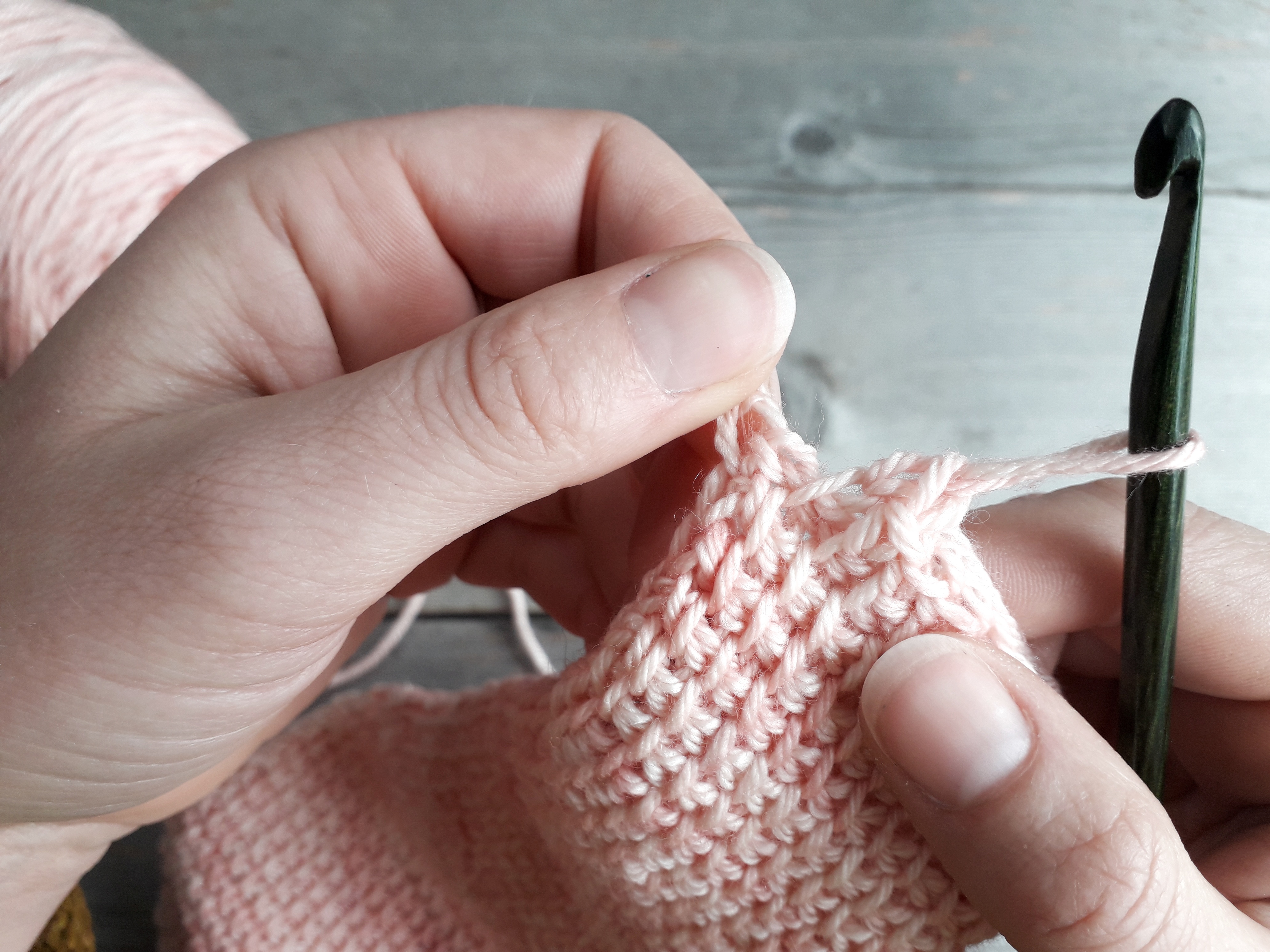
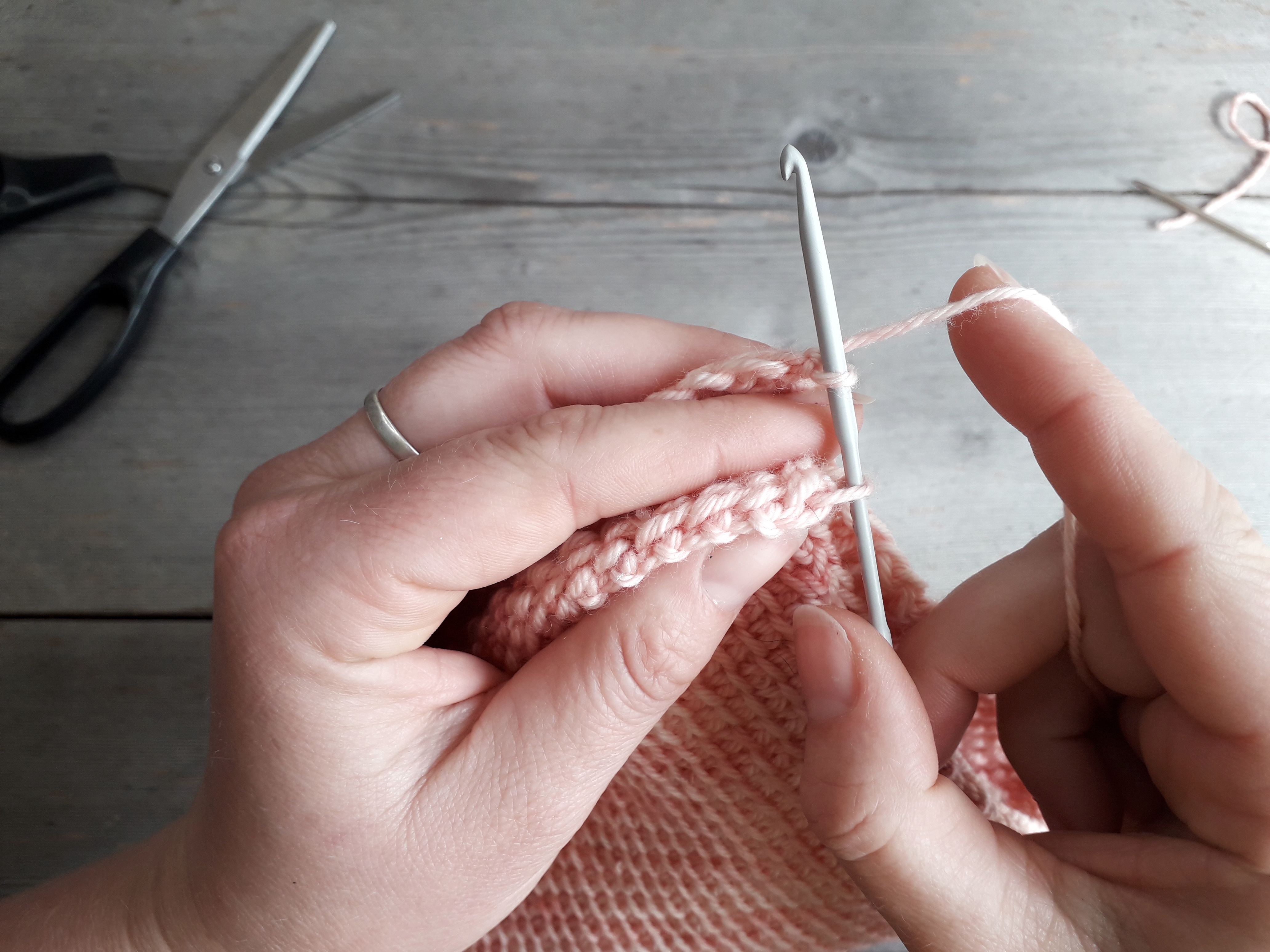
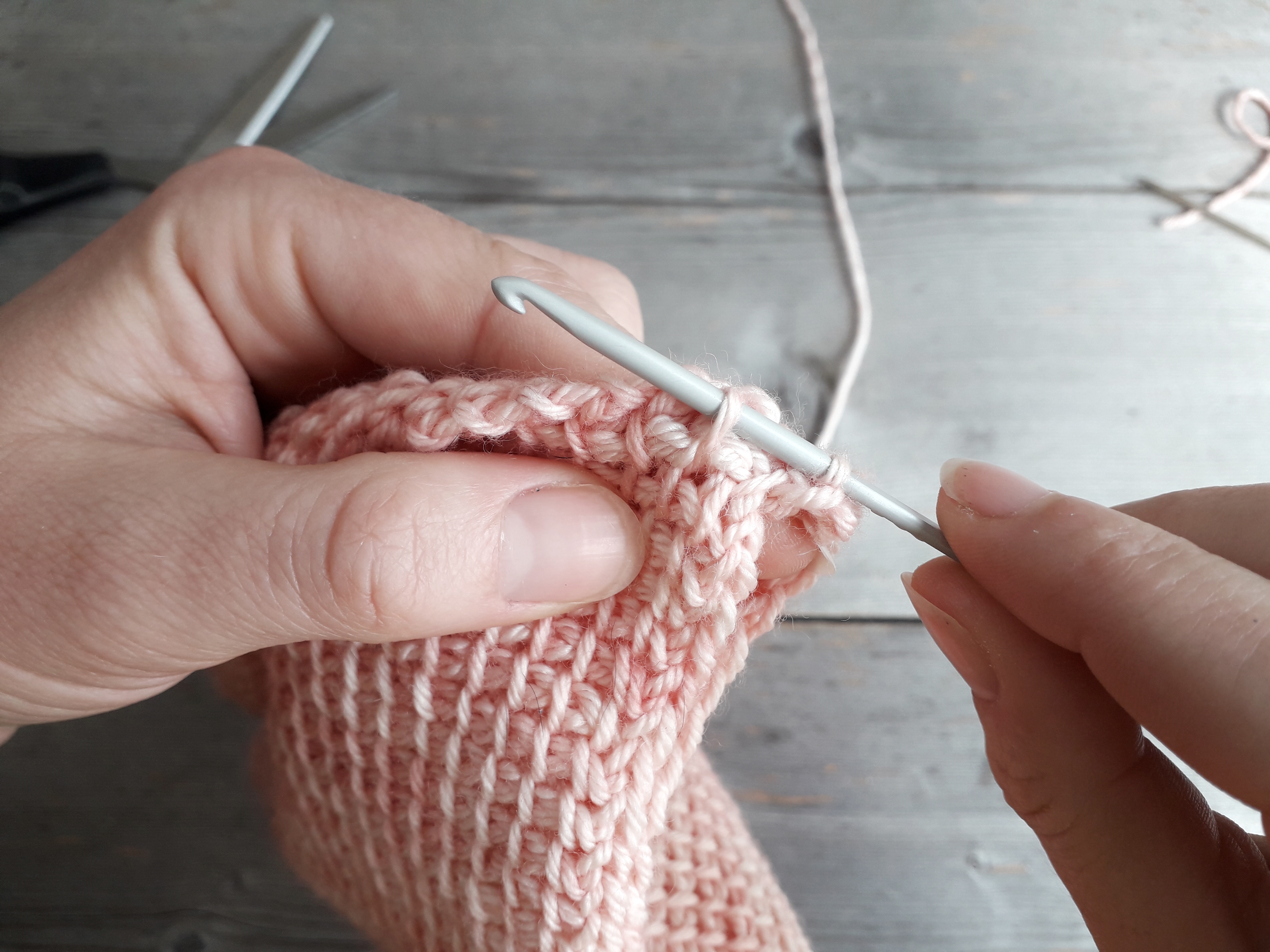
a half-complete row of UK double crochet / US single crochet stitches is being worked across a row of Tunisian Simple Stitches by a green hook.
A row of double crochet stitches in progress.

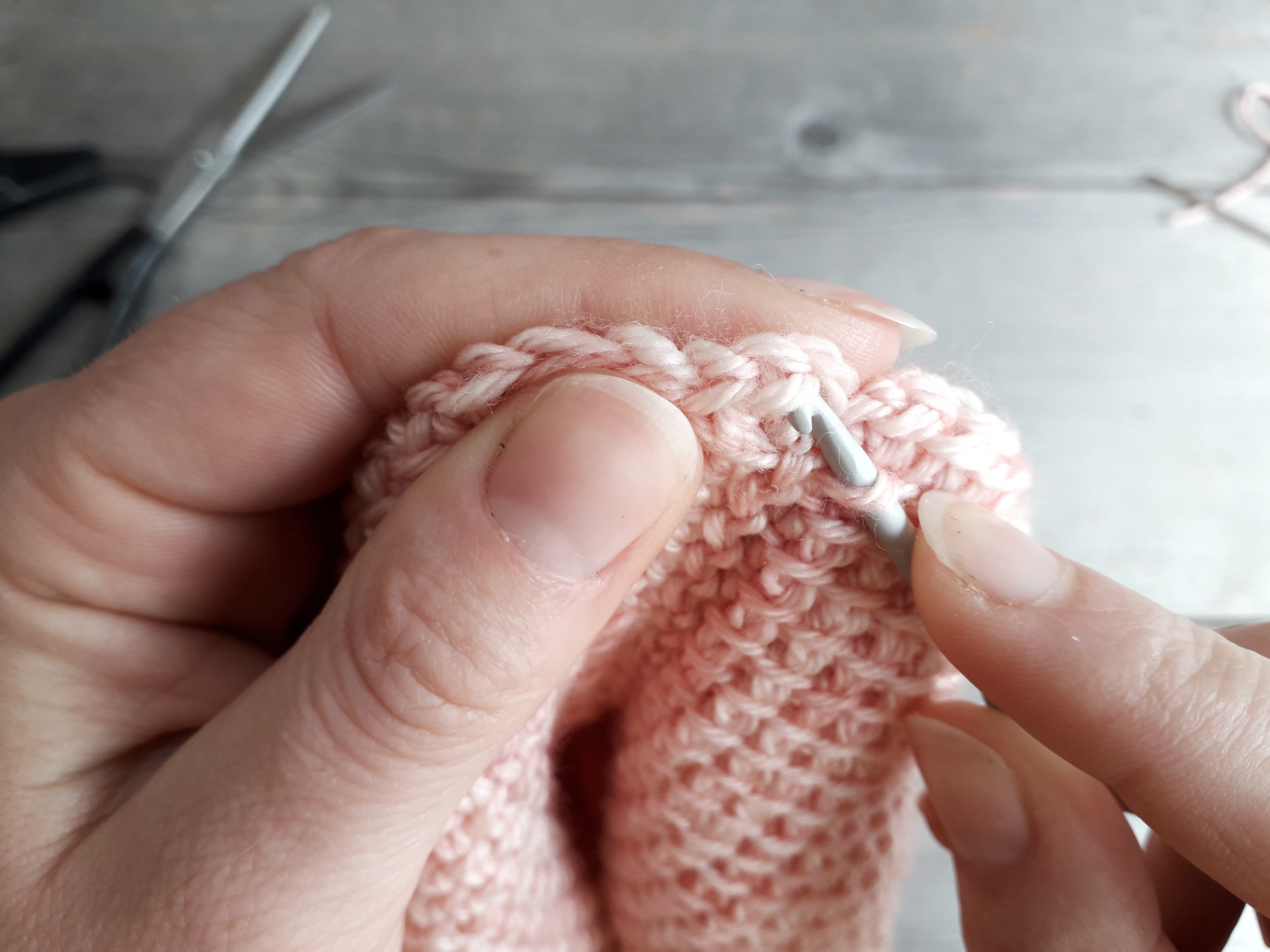
Once you’ve completed a row of double crochet stitches, add a slip stitch to the chain at the end of the row.
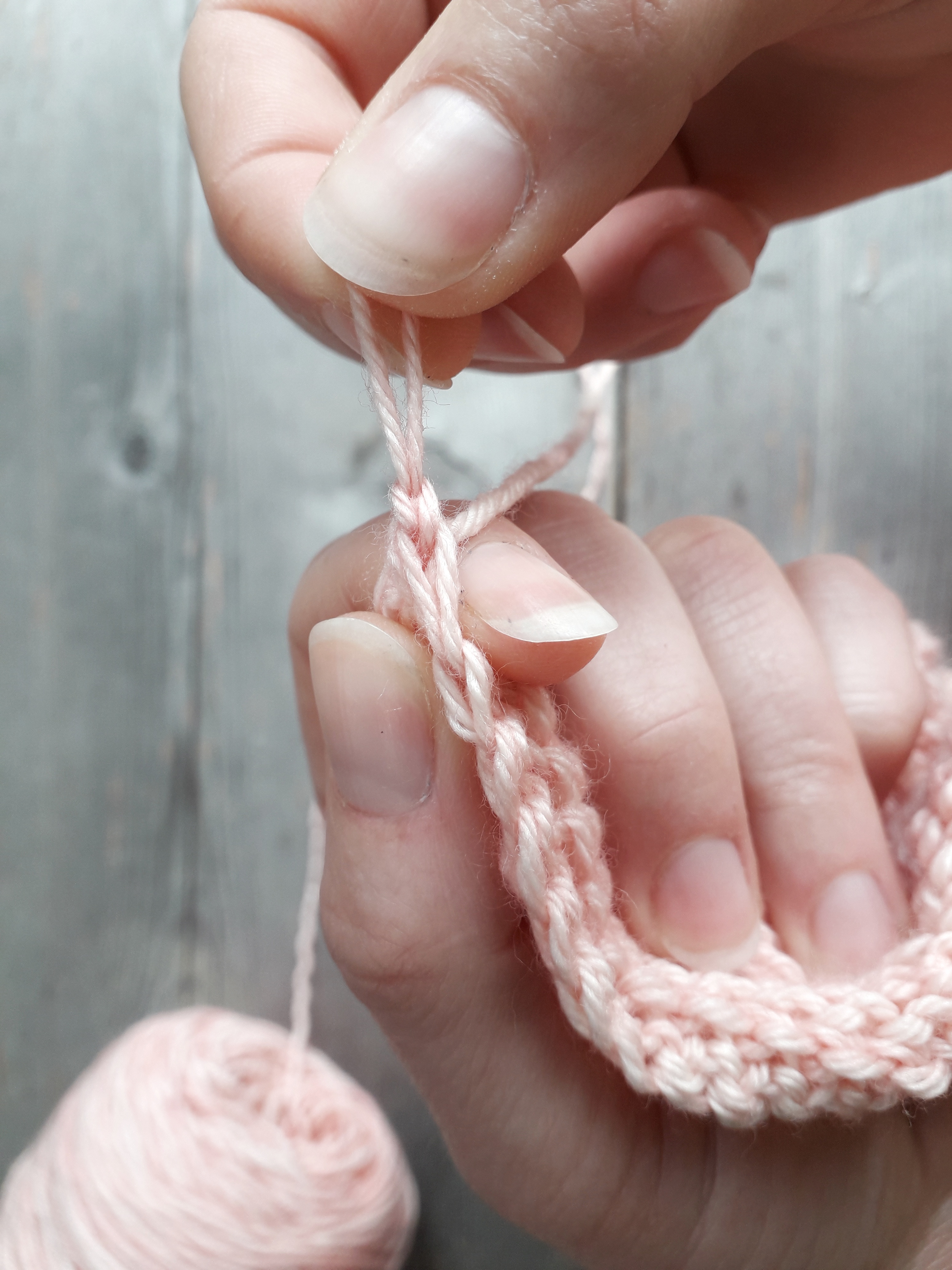
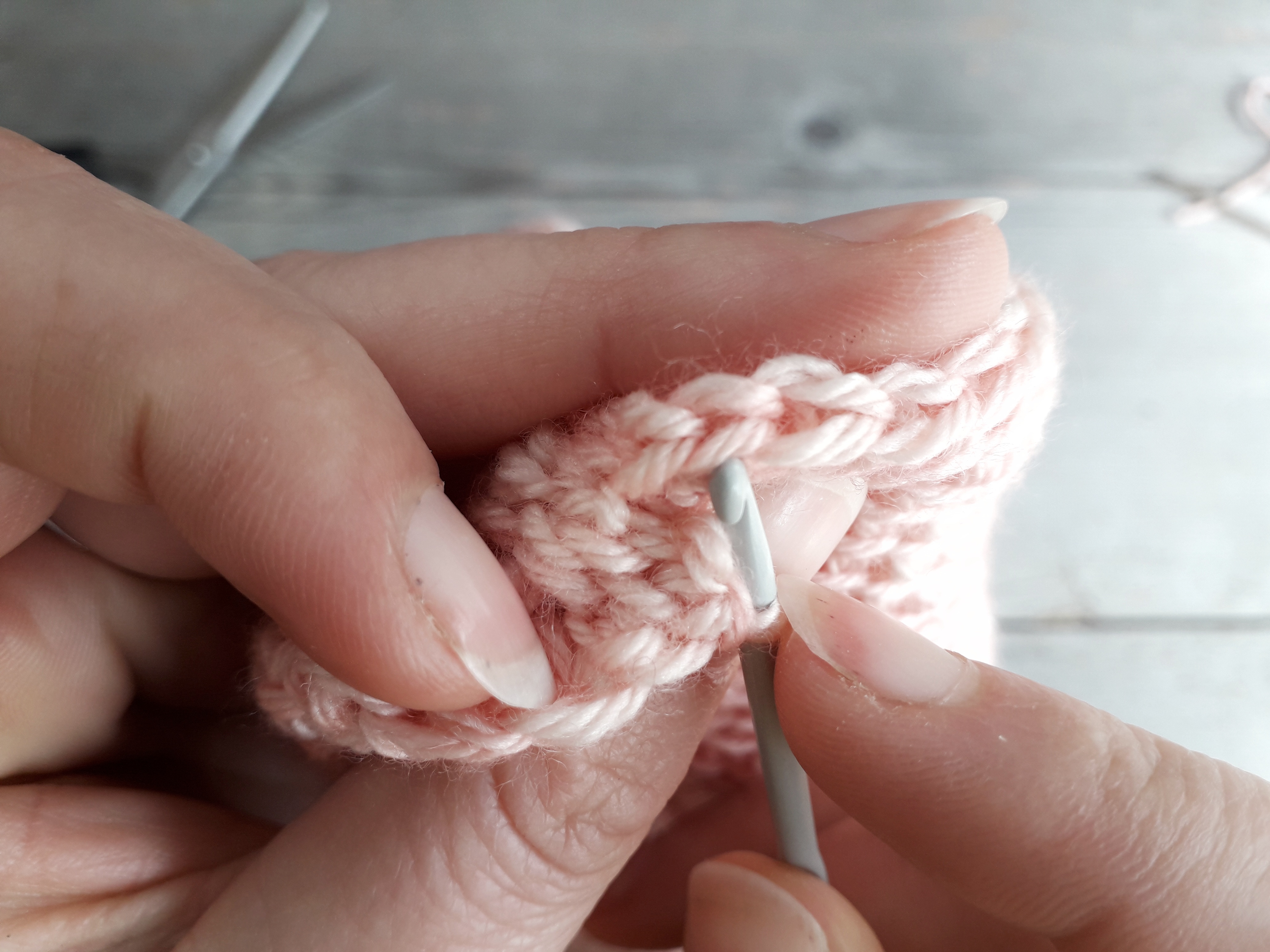
If you have trouble finding the chain, draw your pinched fingers diagonally across your fabric towards the corner. The last loop you catch hold of at the corner is the chain (pictured below).

Peach/Pink crochet fabric is held between two hands. The left hand is pinching a loop at the corner of the fabric while the right hand holds a green crochet hook with one loop on it.
The loop my left hand is pinching is the chain where you will put a slip stitch.

Once the slip stitch is in place, make the loop on your hook larger, and remove the hook. DO NOT bind off.
Take hold of the loop and pull firmly on both sides (pictured below).
You will notice the slip stitch tightens up as you pull. This is an old Irish Crochet Lace trick and it neatens and sharpens up your corner.

Peach/Pink crochet fabric is held between two hands. The left hand is holding the fabric while the right hand is holding a live loop of yarn.
The smallest V right under the loop is the slip stitch.


This seam is easier to work up if you use a smaller hook.
I made this fabric with a 5.5mm hook and worsted weight yarn, so I’m seaming with a 3 mm hook.

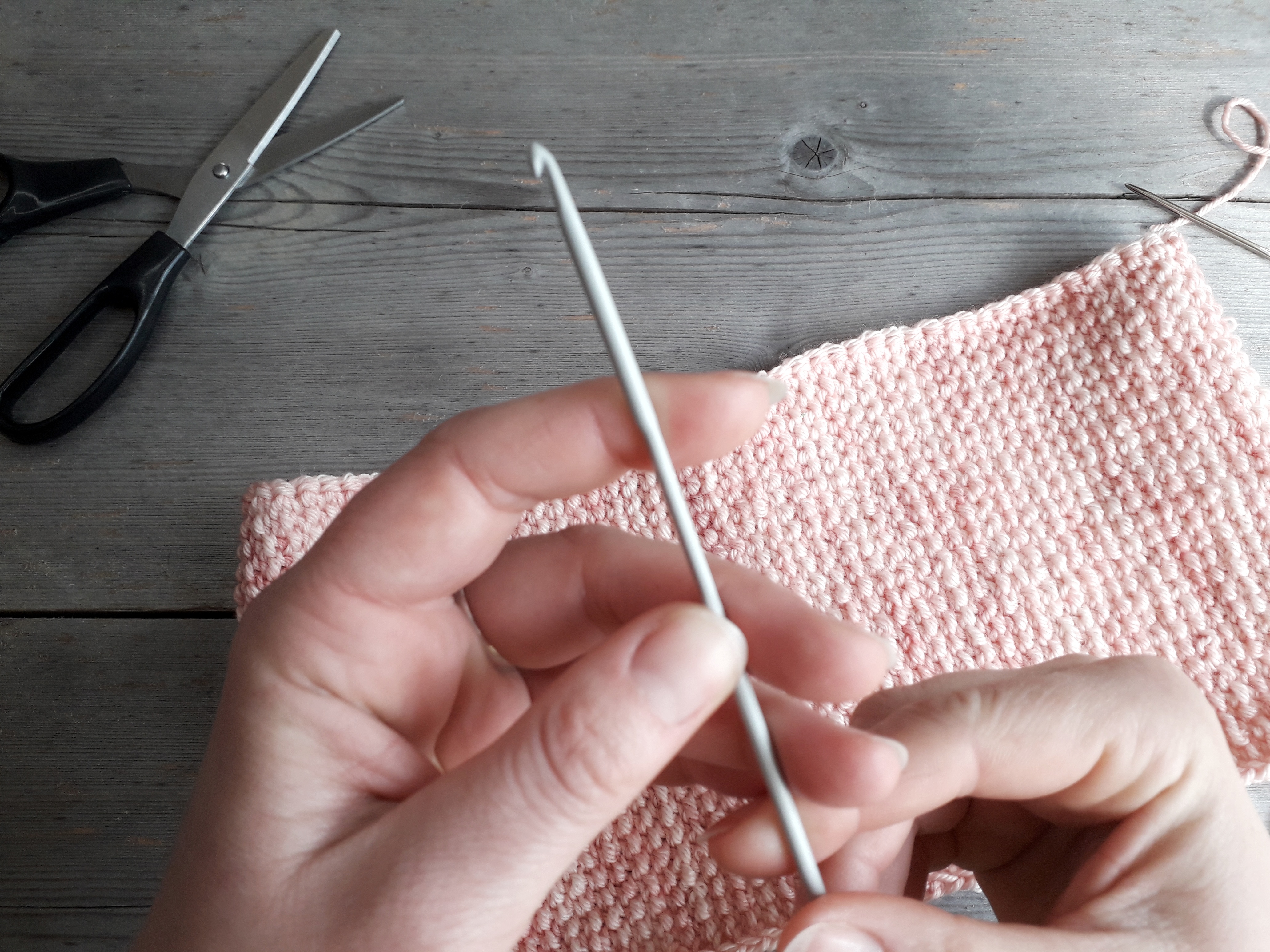
Peah/Pink Tunisian crochet fabric is resting, wrong side up, on a weathered wooden surface. Closer to the camera two hands are holding a 3 mm steel crochet hook.
This 3 mm steel hook is my go-to for herringbone seams

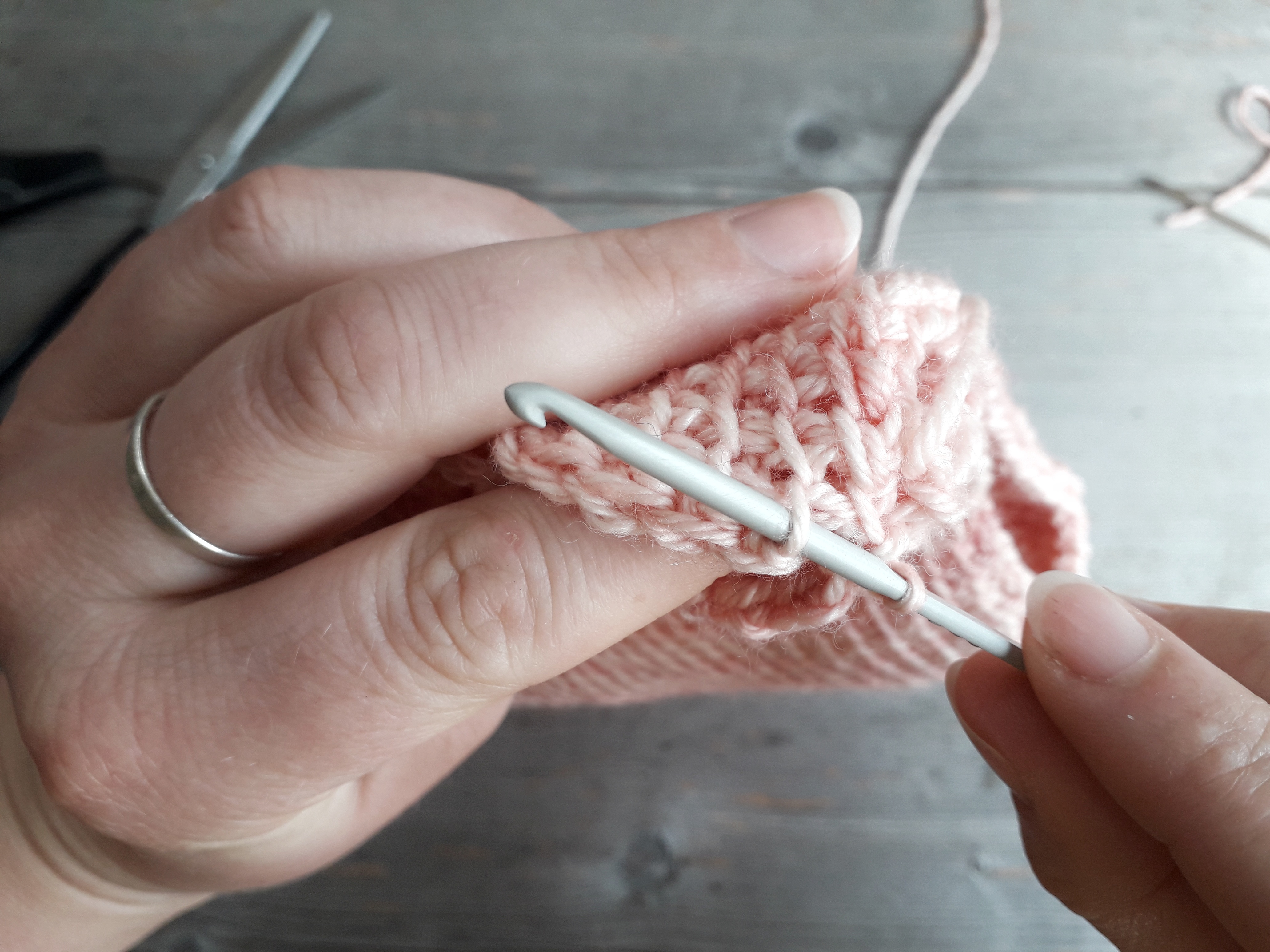
With the wrong sides of your fabric facing in, fold fabric in half so that the first and last rows are parallel.
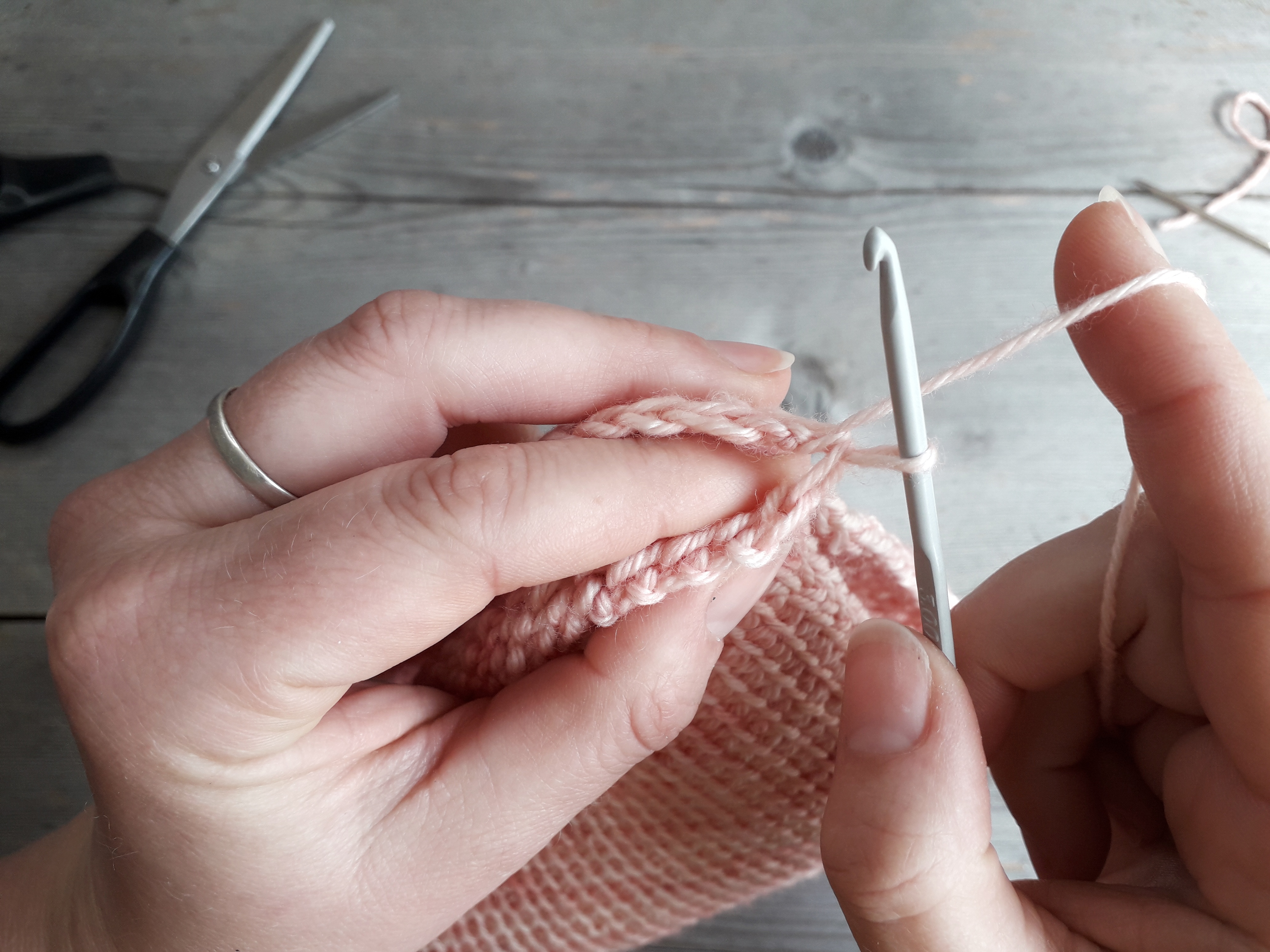
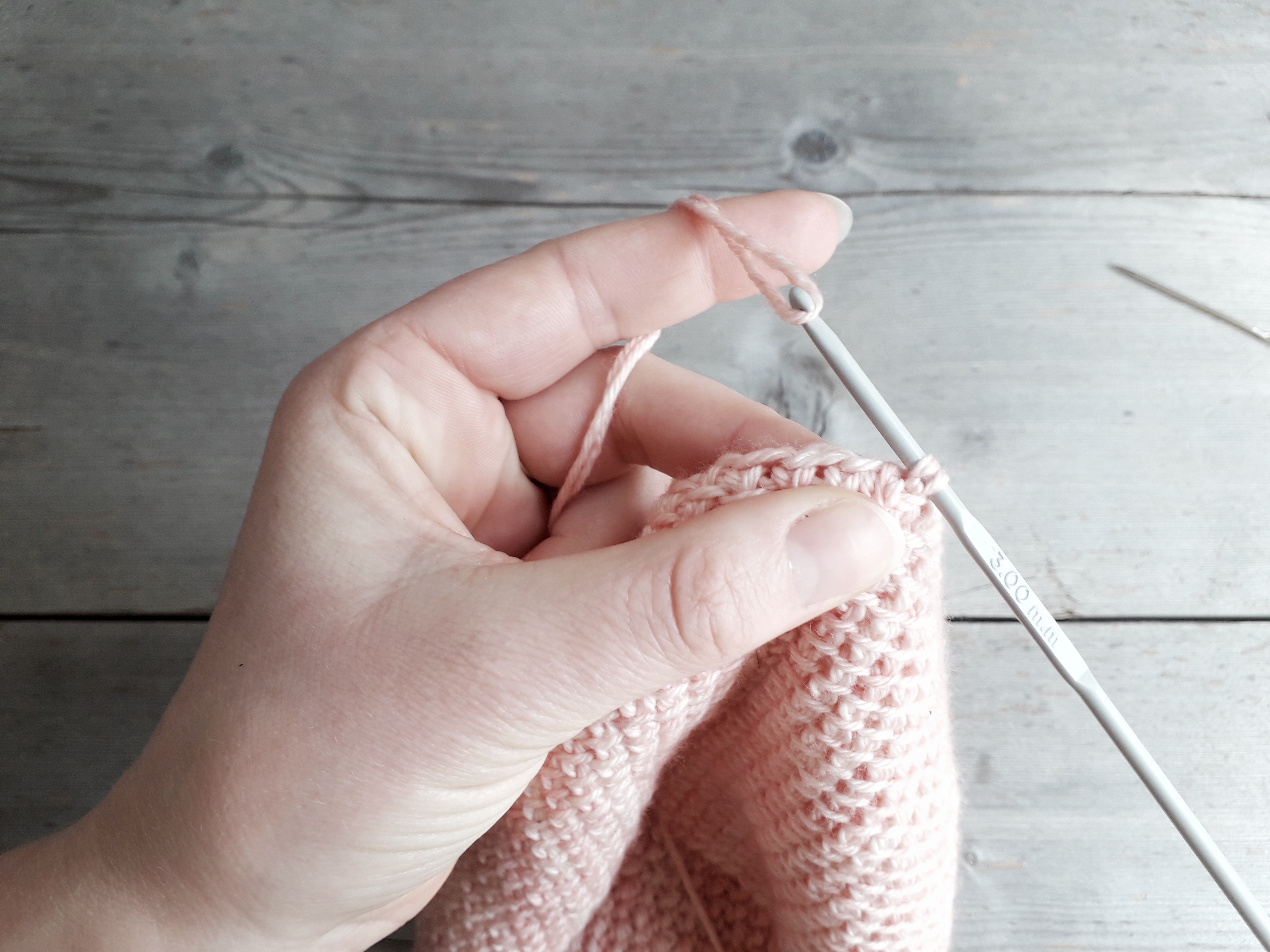
With the first row closer to you, insert hook into chain at the corner. Then, pick up the loop attached to the ball (pictured below).


Draw loop through chain (pictured below).
Cut yarn and leave a tail. This tail will be woven in at the very end. For now, leave it be.


Here is where the seaming fun begins!
Insert hook into the first line along on the fabric closest to you (pictured below).
Then draw the line through the loop already on your hook – 1 loop on hook.
Don’t worry if it feels a little tight, that’ll even out as you work.


Then, insert your hook into the first line along on the fabric farthest from you (pictured below).
Draw the line through the loop already on your hook – 1 loop on hook.


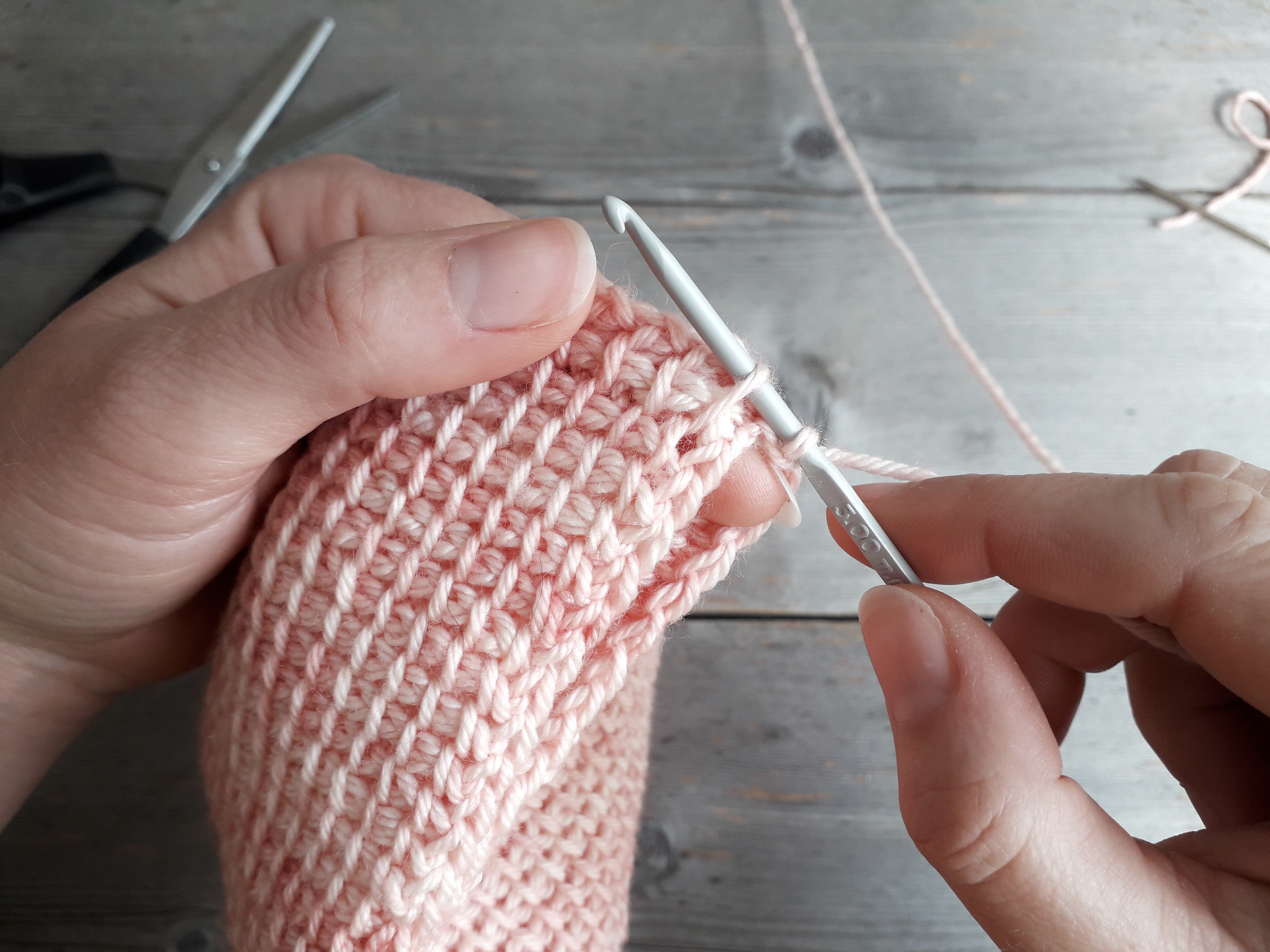
Continue picking up lines and drawing them through to loop on your hook, alternating from front to back.
It may appear as if the seam is a bit tight when compared to the surrounding fabric, but it all settles down once the seam is complete.


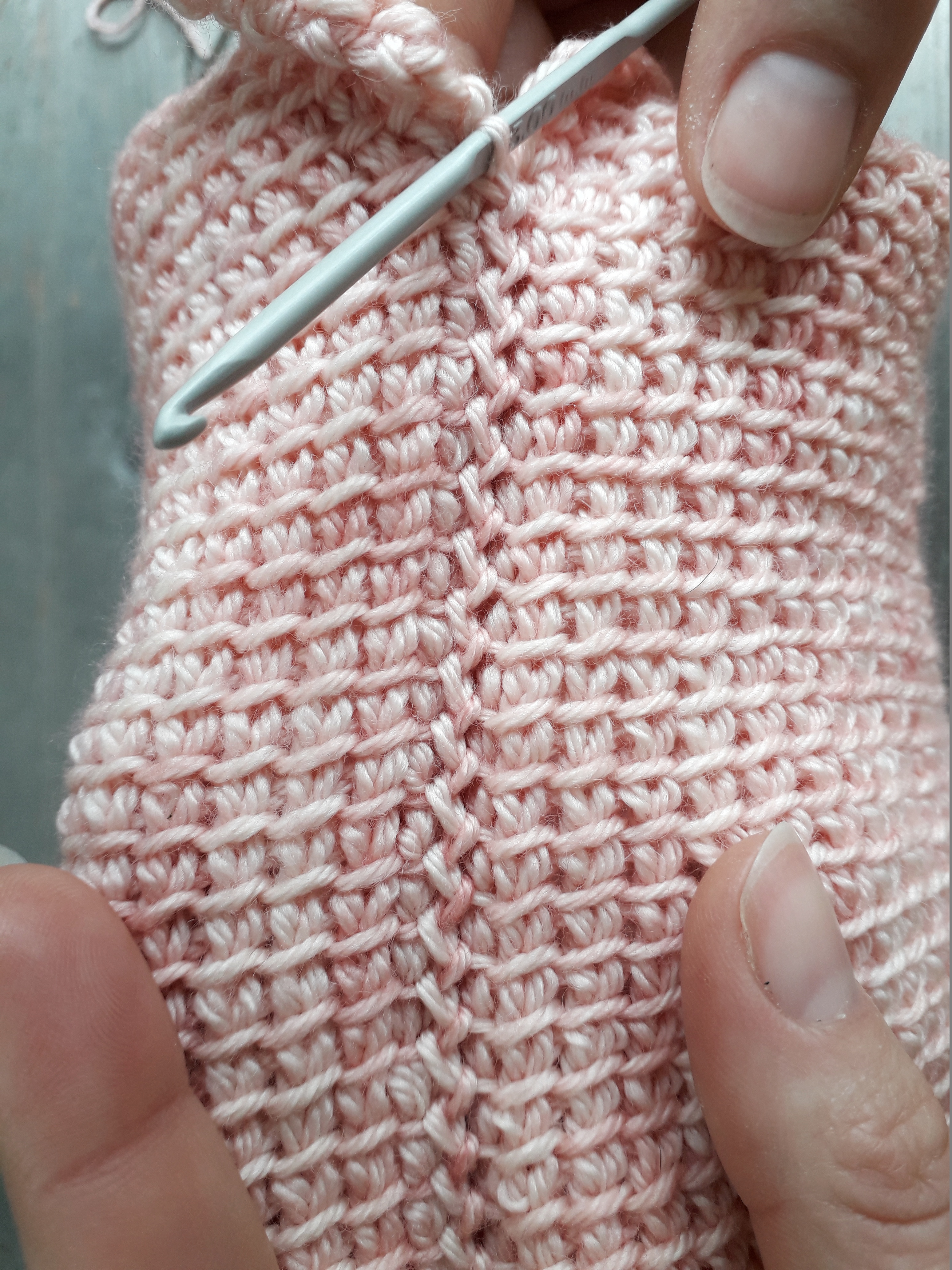
This is what the seam will look like when worked up correctly.


Once all the lines have been used up, there is till a slight gap at the top of the seam to be considered.
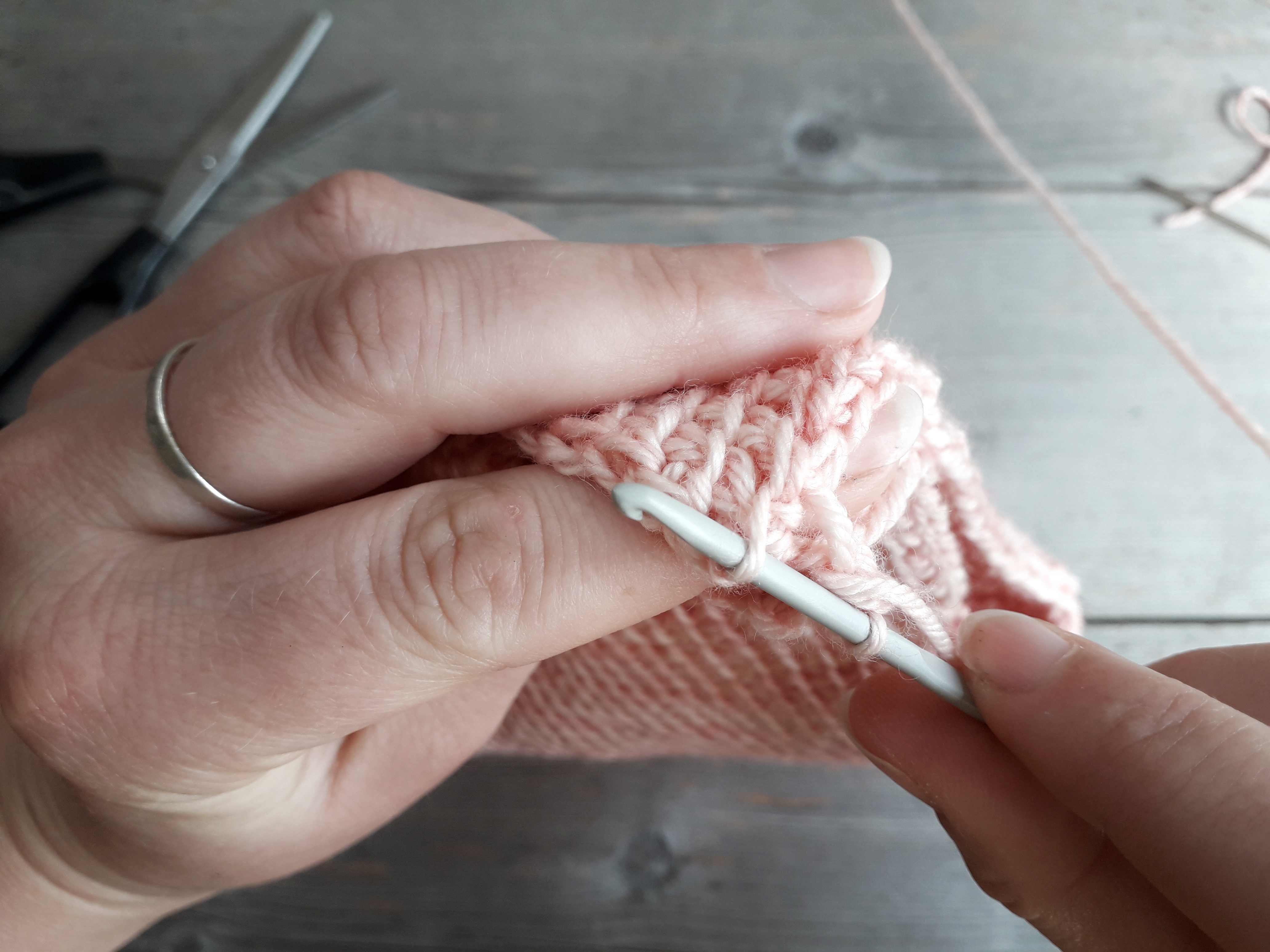
There will be a V on the corner of either side. Insert hook into the V on the fabric closest to you (pictured below).
Then draw both sides of that V through the loop already on your hook – it’ll look like there’s now two loops on your hook.


Do the same thing with the V on the fabric farthest from you (pictured below).
Draw both sides of that V through the loops already on your hook.


You will no doubt have noticed this seam has no strand of yarn to bind off or sew in and no way yet to stop your seam from undoing itself at a moment’s notice if you remover the hook.
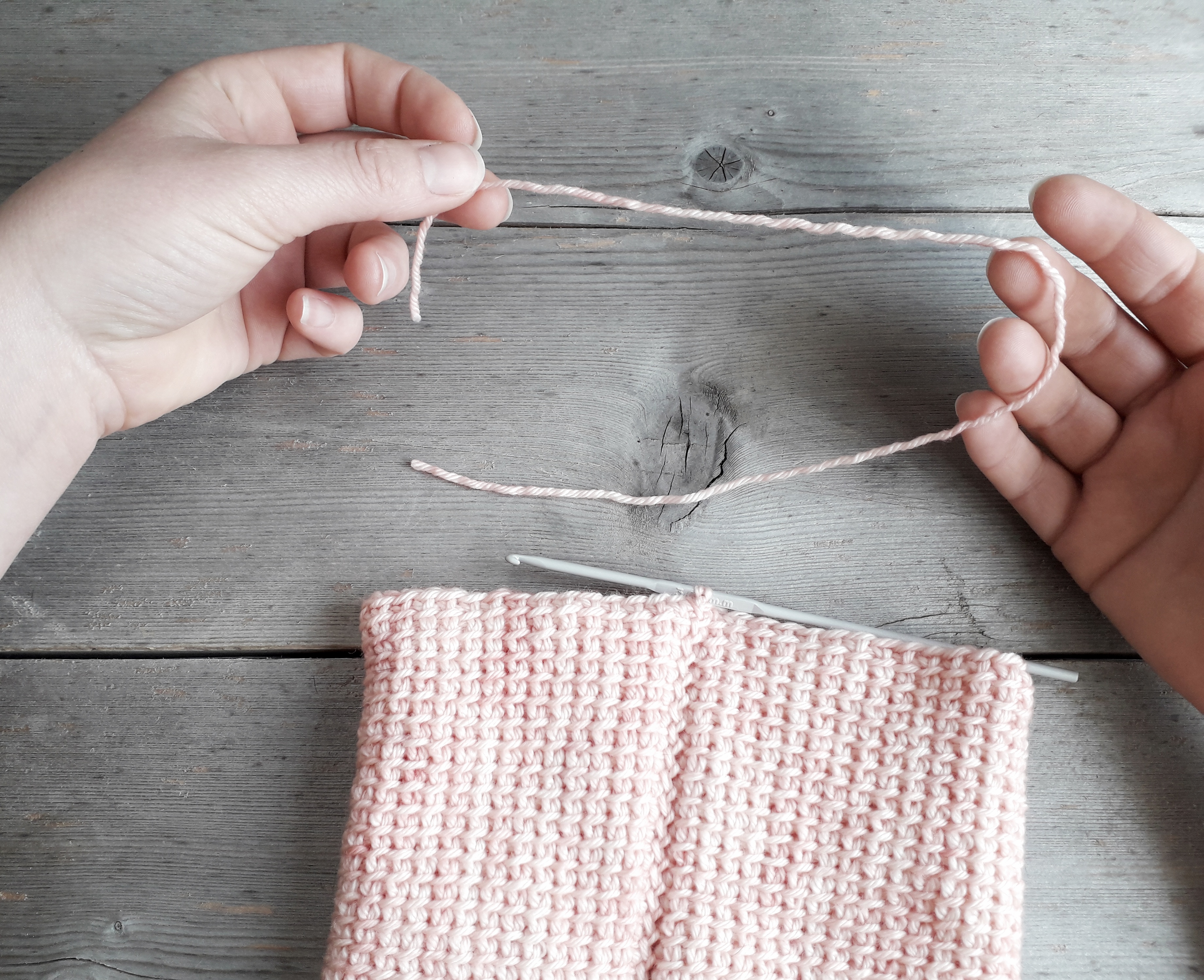
We’ll solve that problem now by cutting a short strand of yarn (pictured below).

A 6 inch strand of yarn is all you’ll nbeed to secure and finish this seam.

Loop the strand of yarn over the hook, pull it through the loops already on your hook.
Remove hook.


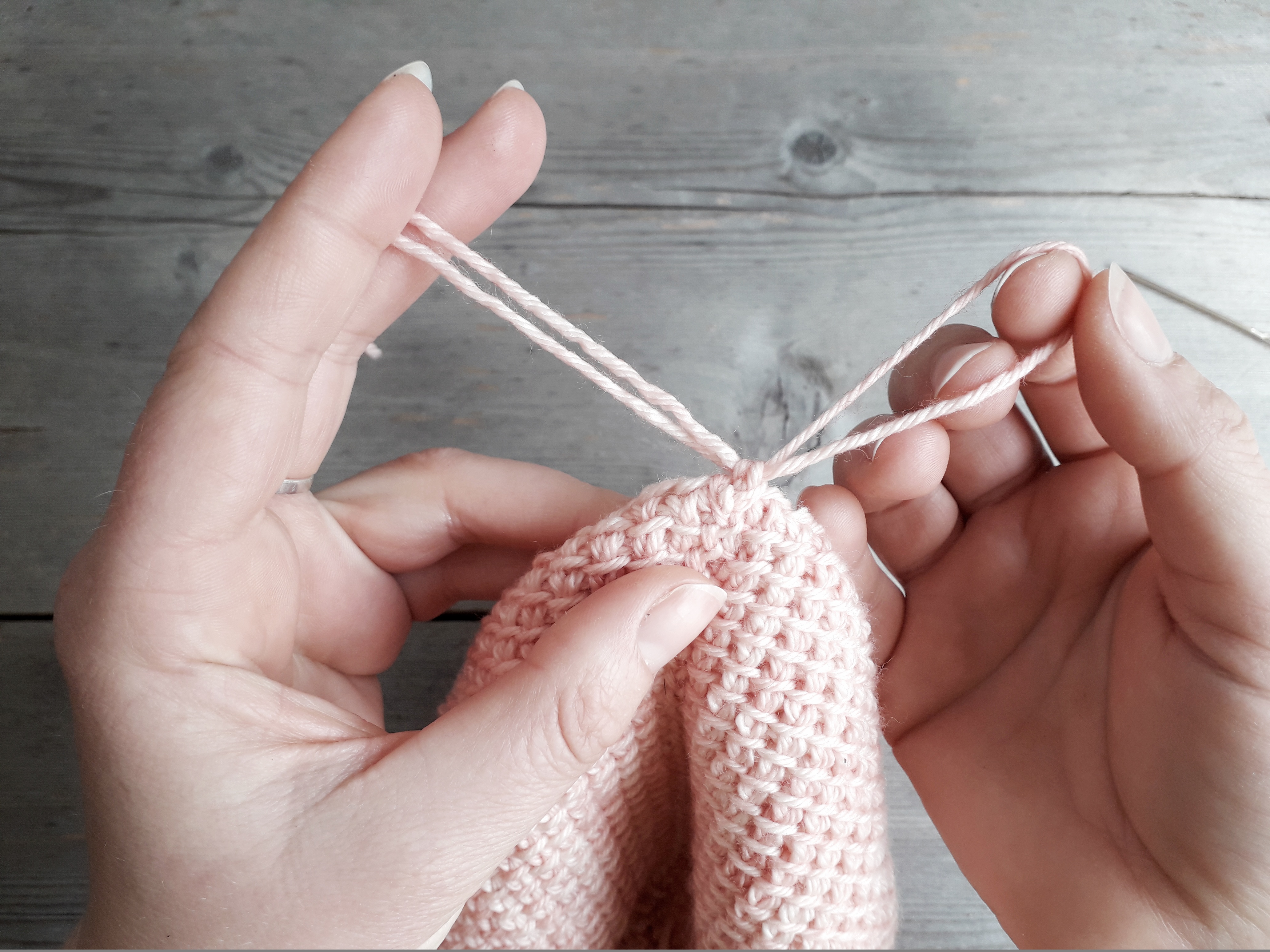
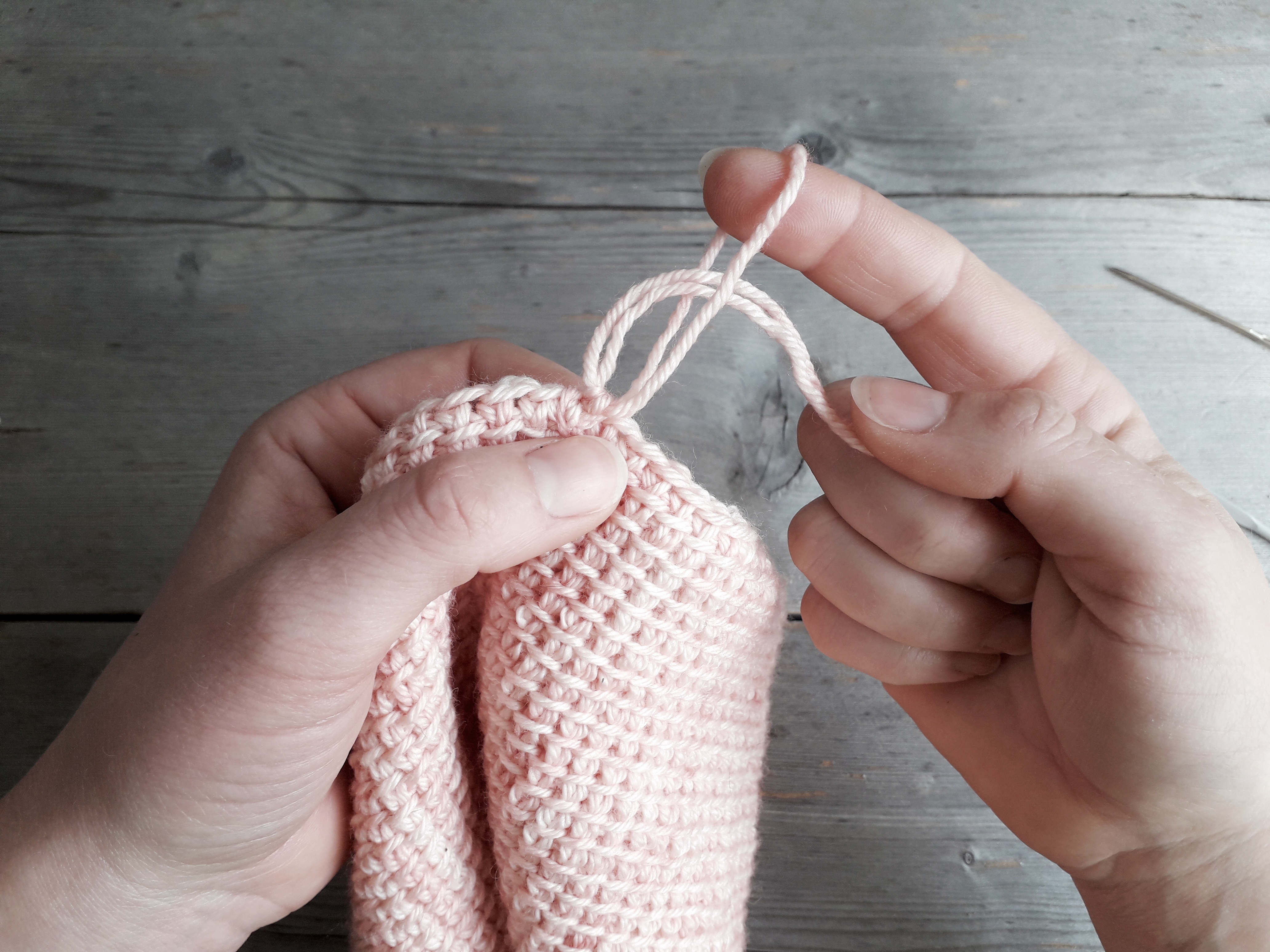
Thread ends through loop (pictured below), then pull ends firmly to tighen knot.

Note: Girl Guides, sailing people and macramé enthusiasts know this knot as the “lark’s head” knot.
(Guess which crochet designer is still very proud of her Brownie Badge for rope-tying and knots)


Once tightened, the two resulting ends can be threaded onto a sewing needle and woven in like regular yarn ends.
To settle the herringbone effect along the seam and to release any pressure it might be under, gently tug both ends.


Remember that tail we left at the very beginning? You can tighten that up now if it’s loosened and weave it in.
Once that’s done, sit back and admire your new seaming skills.

Well done!

Oh, hey, and, if you’d like to use this seam on fabric made from any other Tunisian Crochet stitch, all you have to do is replace the first row after your foundation row with a row of Tunisian Simple Stitch. Then you can make the rest of the project however you wish.

That row of TSS will be your seam.


Did you enjoy this tutorial? Tell me in the comments below!
And hey, tell your friends too!


— ALSO ON THE BLOG —

Posted on 17 Comments

What makes an EASY Tunisian Crochet GIFT idea?

a pile of spiral crochet face scrubbies, piled from dark (at the bottom) to light (at the top)


Looking for an easy Tunisian Crochet gift pattern? Look no further!


If you want to make a handmade gift, but you’re short of time AND yarn, then this nautical-themed, easy Tunisian Crochet gift pattern is just what you need.

Grab some left-over scraps, root out your trusty 5 mm (H) hook and let’s get started!

What Makes This a Good Gift?

Crochet scrubbies are an eco-friendly alternative to cotton circles/make-up removers.

They are infinitely re-usable so they reduce waste.

These scubbies have a soft side for gentle cleansing and a more textured side for stubborn make-up. They are machine washable, too. Each little scrubbie uses just 10 m of Cotton DK weight yarn.

Make them with a 5 mm (H) hook.
You’ll find the free pattern below.

An Easy Tunisian Crochet pattern to make on a budget. Brown, Tan, Stone and White spirals of Tunisian crochet lie together on a white surface.

They’re also very cute, and piled up high would make a great gift for a friend or welcoming touch in a guest bathroom.

If you’d like to make them to sell, please be sure to credit Aoibhe Ni as the designer on the label and add my web address (www.YarnTowers.com)

Right, so let’s get stuck in!

Tunisian Crochet Sea Shell Scrubbies

ESSENTIAL PATTERN INFO
Yarn Used: Paintbox Cotton DK (approx 10 m each)
Colours used: Coffee Bean, Soft Fudge, Vanilla Cream, Light Champagne

Hook: 5 mm crochet (H)
Even though this is a Tunisian Crochet pattern, a regular length hook is all you'll need)

Size: Across its widest point, each scrubbie is 9 cm / 3 1/2 in

Abbreviations:
ch        chain
ss        slip stitch
dc        double crochet
ch-4 loop chain 4 loop (the loop at the centre of the scrubbie)
- 5 sts   stitch count
YO        Yarn Over
st        stitch
[2 dc]    [] are used to identify all the stitches in an increase/cluster
**        repeat the instructions located between *asterisks* the number of times specified in pattern.

Note: This pattern is written using UK stitch terms.
For US users: UK dc = US sc   and   UK tr = US dc

To Begin:

Make 4 chains, then work 1 ss into the chain farthest from the hook to make a circle.
This circle will be the centre of your scrubbie.

Round 1.

Make 1 ch, then into the ch-4 loop work 3 dc,
(Place a lockable stitch marker in the 1st dc worked. It’ll come in handy later)

1 tr,
Note: The treble crochet stitch (US double crochet) you have just completed has a diagonal line of yarn on its surface. This is the Yarn Over you made at the beginning of the stitch.

Work hook into that Yarn Over, then YO and draw up a loop – 2 loops on hook.
work hook into ch-4 loop, YO and draw up a loop – 3 loops on hook.
*YO, draw through 2 loops* repeatedly until 1 loop remains on hook

Examine the st you have just completed.
There is a line half way down its length on the Right Side of your work (the “Right Side” is the side facing you).

Work hook into that line, YO and draw up a loop – 2 loops on hook.
Work hook into ch-4 loop, YO and draw up a loop – 3 loops on hook.
*YO, draw through 2 loops* repeatedly until 1 loop remains on hook

Making stitches with 2 lines


YO hook, then work hook into the line visible on previous st, YO and draw up a loop – 2 loops on hook.
work hook into ch-4 loop, YO and draw up a loop – 3 loops on hook.
*YO, draw through 2 loops* repeatedly until 1 loop remains on hook

**Work hook into the Yarn Over from the previous st, YO and draw up a loop – 2 loops on hook.
Then work hook into the line visible on previous st, YO and draw up a loop – 3 loops on hook.
Work hook into ch-4 loop, YO and draw up a loop – 4 loops on hook.
*YO, draw through 2 loops* repeatedly until 1 loop remains on hook** repeat this section one more time.

Making stitches with 3 lines


YO hook, then work hook into the nearest line on previous st, YO and draw up a loop – 3 loops on hook.
Then work hook into the next line down on previous st, YO and draw up a loop – 4 loops on hook.
work hook into ch-4 loop, YO and draw up a loop – 5 loops on hook.
*YO, draw through 2 loops* repeatedly until 1 loop remains on hook

**Work hook into the Yarn Over from the previous st, YO and draw up a loop – 2 loops on hook.
Work hook into the next line down on previous st, YO and draw up a loop – 3 loops on hook
Work hook into the next line down on previous st, YO and draw up a loop – 4 loops on hook
Work hook into ch-4 loop, YO and draw up a loop – 5 loops on hook.
*YO, draw through 2 loops* repeatedly until 1 loop remains on hook** repeat this section one more time.

Making stitches with 4 lines

YO hook, then work hook into the nearest line on previous st, YO and draw up a loop – 3 loops on hook.
Then work hook into the next line down on previous st, YO and draw up a loop – 4 loops on hook.
Work hook into the next line down on previous st, YO and draw up a loop – 5 loops on hook.
Work hook into ch-4 loop, YO and draw up a loop – 6 loops on hook.
*YO, draw through 2 loops* repeatedly until 1 loop remains on hook

**Work hook into the Yarn Over from the previous st, YO and draw up a loop – 2 loops on hook.
Then work hook into the next line down on previous st, YO and draw up a loop – 3 loops on hook
Work hook into the next line down on previous st, YO and draw up a loop – 4 loops on hook
Work hook into the next line down on previous st, YO and draw up a loop – 5 loops on hook
Work hook into ch-4 loop, YO and draw up a loop – 6 loops on hook.
*YO, draw through 2 loops* repeatedly until 1 loop remains on hook** repeat this section one more time.

Count Your Stitches

Counting Stitches (or Rows) in Tunisian Crochet is very similar to counting them in traditional crochet.
Look at the edge of your crochet until you see the tell-tale V-shape that crochet stitches usually have on their tops. Count those around the outer edge of your scrubbie.

Right now, your count should be 15.

Hands hold a growing half spiral of tan crochet over a white table top scattered with completed Tunisian crochet spirals
Round 1 complete.

Round 2.

Now, it is time to start increasing as we crochet.
Increasing will help keep the scrubbie flat and stop it from turning into a bowl shape.

**Work hook into the nearest line on the previous st, YO and draw up a loop – 2 loops on hook.
Then work hook into the next line down on previous st, YO and draw up a loop – 3 loops on hook
Work hook into the next line down on previous st, YO and draw up a loop – 4 loops on hook
Work hook into the next line down on previous st, YO and draw up a loop – 5 loops on hook
Work hook into the first dc of Round 1 (It’s marked with a lockable stitch marker. Remove marker before continuing), YO and draw up a loop – 6 loops on hook.
*YO, draw through 2 loops* repeatedly until 1 loop remains on hook** three times in total

NOTE: This section tells you to work ALL THREE of the above repeats into the FIRST dc st of Round 1.
This means the second and third time you pick up a loop in the scrubbie fabric, you will be doing it in the same stitch space as the first repeat.


Once done, your first 3-stitch cluster will be complete.

Using the above instructions as a guide, make the same 3-st cluster in the next 5 stitch spaces along.

Count Your Stitches

Once all 6 of the 3-st clusters are in place, count around the outer edge of your scrubbie.
Some stitches from the Round 1 have been covered by the stitches we have worked in Round 2.
The covered stitches should not be counted in the total.

Right now, your count should be 27.

hands hold a spiral teardrop shaped piece of tan Tunisian crochet over a white table top scattered with completed Tunisian crochet spirals
Round 2 complete.

Finish off your Crochet Gift.

Edge:

For the last little section, we revert back to traditional crochet.

You may have noticed, the last Tunisian Crochet stitch you made is always a little loose and wobbly. We are going to fix that now by working some UK double crochet stitches (That’s a single crochet in the US) into the edge of our stitch to fill it out and give it some strength.

Adding Double Crochet Stitches to your Tunisian Crochet Fabric

Work hook into the nearest line on the previous st, YO and draw up a loop – 2 loops on hook.
YO and draw through 2 loops – 1 loop on hook.
That’s our first double crochet complete.

*Work hook into the next line on the previous st, YO and draw up a loop – 2 loops on hook.
YO and draw through 2 loops – 1 loop on hook* repeat this two more times

Count Your Stitches

Laid out behind your hook, on the edge of your Tunisian Crochet, you will see a line of V-shapes.
Count those. You should have 4 in total.


a red hook holds one loop of light brown yarn. The Tunisian Crochet face scrubbie is almost complete, with four single crochet stitches added to the last row of Tunisian Crochet.

Complete your Tunisian Crochet Gift

Work 1 dc into the corner that is directly in front of your hook.
(There is a hole right in that corner that was made by the last 4-st cluster you worked. That’s an ideal spot of use.)

Then, working around the outer curve of the shell, work *[2 dc], 1 dc* 13 times

single crochet stitches being added to the curving edge of a tan spiral of Tunisian Crochet
half way through the dc edge of the scrubbie.

Into the st on the very corner of shell, make [2 dc].
Then, Bind Off and sew in ends securely.

The outer edge of a spiral piece of crochet has been completly covered in single crochet stitches.
the last [2 dc] in place, ready to be bound off.

Did you enjoy this easy Tunisian Crochet gift pattern tutorial?
Tell me in the comments below!

And hey, tell your friends too!

— MORE TUNISIAN CROCHET GIFT IDEAS —

— ALSO ON THE BLOG —
Posted on 28 Comments

Is Tunisian Crochet faster than Regular Crochet?

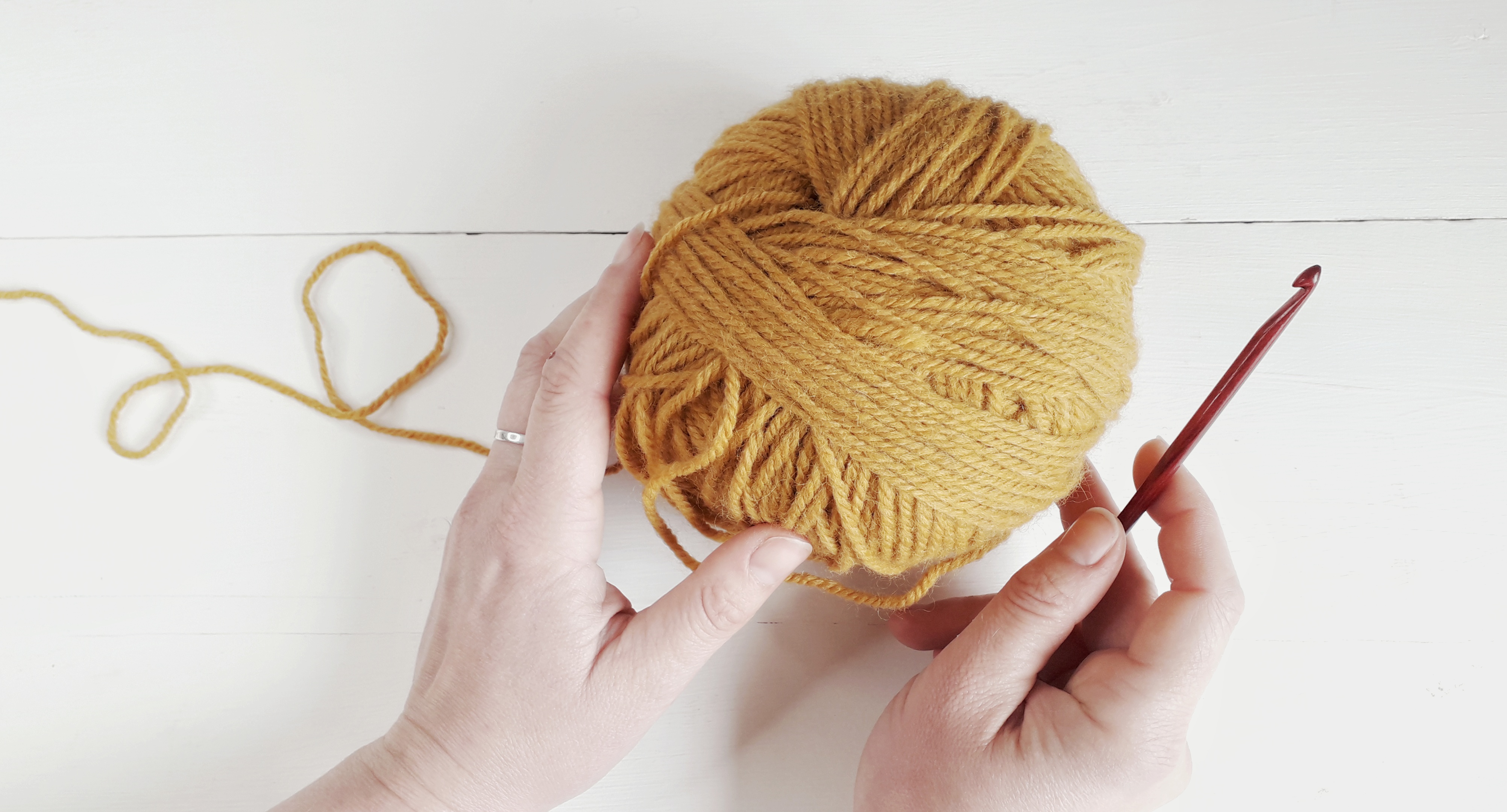
two hamds hold a large ball of warm yellow yarn on top of a painted white wooden surface. In the right hand is a crochet hook


I’ve wondered for years if Tunisian Crochet is faster than regular crochet.
Which uses more yarn? Do they come out the same size?
I decided to find out once and for all.
Let’s get into it!

Say it with me; “A test is fair if everything about the things being tested is equal, except for one, measurable difference.”
My science teacher in school made us all memorise that little saying.

In layman’s terms it means that if you want to answer any of the above questions, you have to keep everything equal.
You have to use the same yarn, the same hook, do it on the same day, while sitting in the same chair, watching the same Netflix show, and use the same number of stitches for both swatches.

In this test, therefore, the only difference I’ve allowed is the one we’ll be measuring;
One swatch will be using regular, traditional crochet & the other will be composed of Tunisian Crochet.

I’ll be using a 5 mm hook for each swatch, and Aran weight wool/Acrylic blend yarn.
Each swatch will have 15 stitches across, and will be 15 rows tall.

two hands hold a swatch of traditional crochet in yellow yarn against a painted white wooden surface

This is my Traditional, regular crochet swatch.

It took precisely 13 minutes to complete which – if you want to get technical – means each stitch took me an average of 3.4 seconds to make.
It used a total of 6 grams of yarn
and it measures 10 cm across x 9.5 cm tall.

Sooo close to being a perfect square! So close!


two hands hold a swatch of Tunisian crochet in yellow yarn against a painted white wooden surface

And this is my Tunisian crochet swatch.

This little lady took a smidge longer to finish, clocking in at 14 minutes, 30 seconds.
With the exact same stitch count as the regular crochet swatch, that means each stitch took me on average 3.8 seconds to make.
It used a total of 7 grams of yarn, and it measures 11 cm across x 11 cm tall.

A perfect square, well done, Tunisian!


So, in essence, the difference in speed is negligible.

A Tunisian Simple Stitch stitch takes .4 seconds longer to make than a traditional double crochet stitch (US single crochet), but that slightly slower speed could very well be eliminated and reversed if I had chosen to crochet the 255 stitches in the Tunisian swatch on a bigger hook. I found the 5 mm hook a little too small.

Tunisian is a denser fabric, so it’s no surprise that it used a little more yarn, but not nearly as much as I had assumed it would, which was an awesome surprise. The square also came out a little bigger, so when measuring by area, they pretty much work out equal.
So if Tunisian’s reputation as a yarn hog is what’s putting you off, it might be time for a rethink.

hands hold two swatches in yellow yarn against a painted white wooden surface


Both swatches turned out to be square (though, this Tunisian fan is pleased to see Tunisian come out bang on!)
The fact that both techniques have stitches that are as tall as they are wide makes them infinitely suitable to colourwork and charting using graph paper – and far more versatile than stocking stitch in knitting, which has stitches markedly taller than they are wide.

My conclusion, therefore is that between Tunisian and Regular crochet, the differences in yarn use and time taken are negligible, so feel free to choose the technique that YOU prefer and that’s right for the project you have in mind safe in the knowledge that it’ll all work out well in the end.

Did you enjoy this tutorial? Tell me in the comments below!
And hey, tell your friends too!


— PATTERNS THAT INCLUDE TUNISIAN AND REGULAR CROCHET —

Posted on Leave a comment

Getting the MOST out of a Stretchy Crochet Chain

stretchy chain made from white yarn held over a wooden table. A third loop has been added to hook


So, you have your stretchy crochet chain done, right?
And you’re ready to start a new project?
Brilliant!
Let’s get into it!

a stretchy chain made of white yarn held over a scrubbed wooden tabletop


stretchy chain made from white yarn held over a wooden table. A black arrow is pointing to the "dip" where your hook should go next.
  • The arrow in the image above is pointing to the hole where the last double crochet (US single crochet) of your stretchy chain was worked. It’s also where your hook is going to go to start off the first row of Tunisian Simple Stitch Fabric in this tutorial.

stretchy chain made from white yarn held over a wooden table. Hook has been inserted into the next chain
  • This is what it looks like when your hook is in place.

stretchy chain made from white yarn held over a wooden table. A Yarn Over has been added to hook
  • Yarn Over like you would for a regular TSS

stretchy chain made from white yarn held over a wooden table. The Yarn Over has been pulled through fabric
  • Draw Yarn Over through (1 TSS on hook).

stretchy chain made from white yarn held over a wooden table. A black arrow indicates the location of the next hole.
  • The arrow is pointing at the next hole along in your stretchy chain.
  • As with the first TSS you made, insert hook in this hole.

stretchy chain made from white yarn held over a wooden table. A third loop has been added to hook
  • Yarn Over, draw through to made a second TSS on your hook.
  • Note: There are three loops on your hook but only two TSS sts because the first loop was there from the beginning of the row.

stretchy chain made from white yarn held over a wooden table. An entire row of lopps have been added to hook.
  • Repeat to end of row.
  • Pick up a final loop in the chain st at the very end of your stretchy chain.

A stretchy chain and one row of Tunisian Simple Stitch made from white yarn held over a wooden table.

Remember, the return pass on a piece of Tunisian Crochet like this is:
YO, pull through 1 loop (to make a chain),
then YO and pull through 2 loops repeatedly, until 1 loop remains on hook.


A stretchy chain and multiple row of Tunisian Simple Stitch made from white yarn held over a wooden table.
  • With a few more rows of TSS in place, the “rolled” edge of the stretchy chain becomes a subtle, but very beautiful feature.
    And hey! No tight edge!

Did you enjoy this tutorial? Tell me in the comments below!
And hey, tell your friends too!


— PATTERNS THAT WOULD WORK GREAT WITH THIS TECHNIQUE —

Posted on 6 Comments

The Ultimate Stretchy Crochet Chain

a stretchy chain made of white yarn held over a scrubbed wooden tabletop

Basic old CHAIN STITCHES don’t stretch!
This is a perennial problem for both Traditional and Tunisian Crochet. But luckily, I’ve found a solution. Here’s how to make a STRETCHY CROCHET CHAIN.

Let’s get right into it!

a black crochet hook is held in the right hand while the left hand holds on to two chain sticthes.
  • With a slip knot and loop already on your hook, make 2 chain stitches


a black hook has been inserted into the first chain, there are two strands of yarn on the hook.
  • Insert hook into chain farthest from hook.

A yarn over has been added to the two strands of yarn on the black crochet hook.
  • Yarn Over

The Yarn Over has been drawn through the first chain, leaving two loops on the black hook
  • Draw loop through chain – 2 loops on hook

a second yarn over has been added to the hook. there are now three loops on the black hook again
  • Yarn Over again.

One loop is left on the hook. a small sticth has been made and is being held in the left hand.
  • Draw Yarn Over through both loops on hook – 1 loop on hook
  • (You’ve essentially made a UK dc / US sc st in the first chain)
  • Note: I’ll refer to this as a “double crochet” throughout this tutorial.

a yarn over has been added to the black hook. there are two loops on the hook
  • Yarn Over

a chain stitch sits below the black hook
  • Draw Yarn Over through loop to make a chain stitch

two black arrows point the two strands in the stotch below the chain just made

See these two loops?
The one on the right is part of the V on top of the double crochet just completed.
The one of the left is the SIDE of the same double crochet.
Once you have identified your two loops, carry on to the next step.


a black hook has been inserted into two loops on the previous crochet stitch
  • Insert hook through BOTH loops.

a yarn over adds to the loops on a black hook. there are now four strands of yarn on the hook
  • Yarn Over

two strands of yarn remain on the black crochet hook
  • Draw Yarn Over through both loops – 2 loops on hook

an added yarn over takes the loop count to three loops
  • Yarn Over

a crochet stitch sits below a black hook and is held by two hands
  • Draw Yarn Over through both loops on hook – 1 loop on hook
  • Double crochet complete.

black arrows superimposed on the photo point to dips in the completed stretchy crochet chain

Alternate between a chain and a double crochet by following steps 7 – 13.
Each full repeat gives you an additional stretchy chain. Always end on a double crochet.

See the little dip indicated by the arrows?
That’s where you’ll insert your hook to make your first row of stitches for your project.


— PATTERNS THAT WOULD WORK GREAT WITH THIS TECHNIQUE —

Posted on Leave a comment

How to make a SLIP KNOT

The yarn that was pinched between index and middle finger has been drawn through the crossed strands to make a loop.

The SLIP KNOT! It’s a rare crochet or knitting project that doesn’t begin with this versatile little knot. In this photo tutorial, I’m going to show you step by step how to make one.

Let’s get right into it!

two hands holding up a strand of white yarn. The tail end of the yarn is on the left side
  • Hold the end of your yarn in one hand, and the ball end in the other.

two hands holding up a strand of white yarn. The strands are crossed, with the tail on top.
  • Fold yarn over itself so that the tail is on top.

the index finger and middle finger of the right hand have been poked upward through a loop made by the crossed strands of yarn
  • Poke two fingers through from underneath your yarn loop.

the ball end of the yarn has been groipped between the index and middle fingers of the right hand.
  • Take hold of the ball end of your yarn with your fingers.

The yarn that was pinched between index and middle finger has been drawn through the crossed strands to make a loop.
  • Pull the yarn in your fingers through the loop, making a second loop.

The ball and tail end of the yarn are being held in the left hand while tension is put on the new loop, tightening the crossed strands into a knot.
  • Gather up the tail & the ball end in one hand, and keep hold of the second loop in the other.

a black hook has replaced the fingers in the loop.
  • Remove fingers and replace them with a hook or needle.

The left hand is pulling the ball end of the yarn, which tightens the loop on a black crochet hook held in the right hand.
  • Pulling the ball end will tighten the loop on your hook/needle.
  • Make sure the loop is snug, but not too tight before you begin to crochet/knit.