Posted on 4 Comments

The student that almost made me quit teaching crochet

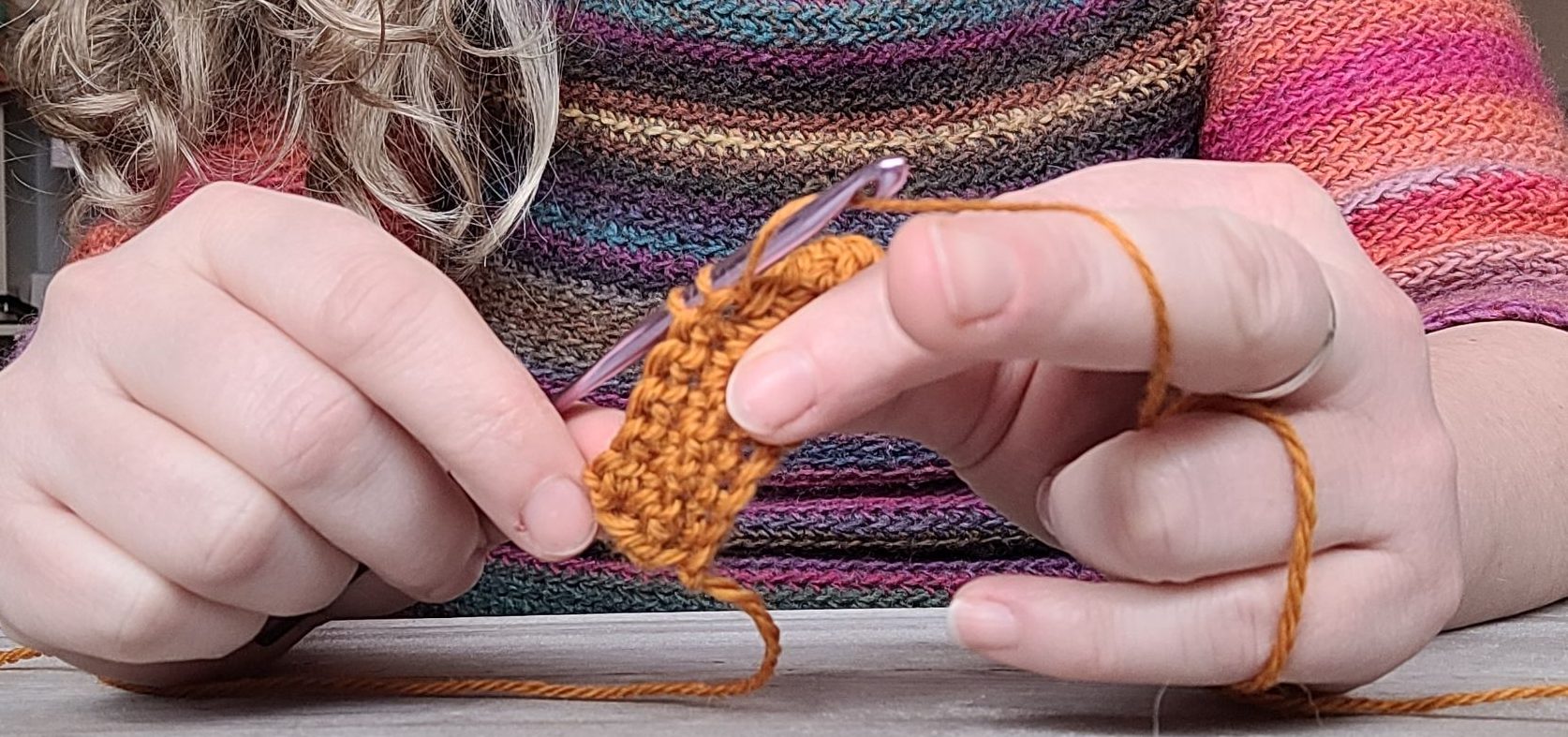
I’ve been teaching sundry traditional crafts classes for a good two decades now, and I pride myself on my patience, gentle encouragement and my ability to help struggling crafters improve at their own pace. I’m happy to repeat, I don’t show impatience, I centre joy and try to teach a love of the craft alongside the necessary skills to succeed.

In fact, up until I met this one student – let’s call her Mary – I actively described myself as a teacher who never left a student behind.

Thanks to Mary, I don’t make that claim anymore.

Now, before you judge me for making fun of a struggling student, hear me out. Stick with me. I promise it’s worth it.

Here’s how it went down.

Mary’s adult daughter contacted me, asking if her, her sister and their mother could book me for a family crochet class. I love working with related students. The dynamic is always brilliant. There are family jokes, a little teasing, well-worn stories to tell, and a comfort between people that you just don’t get at a table full of strangers, so I said yes, I’d love to.

They arrived at my studio, and for the first little while, all seemed normal. They were all beginners, so they all struggled with holding the hook, with managing their yarn, with making chains. But while the two sisters worked and progressed steadily, their mother didn’t.

Now, being as I never let a willing student flounder, I focussed on Mary.

Mary would wrap the yarn around the hook multiple times, and make a tangled, gnarling knot.
I’d remind her she only has to wrap it once.
After I undid the muddle and handed the hook and yarn back, Mary would wrap it multiple times again.

After we’d done that dance for a while, Mary would pull the loops off the hook without wrapping at all, yanking the yarn in the process, thus losing all her stitches.
I’d re-do the lost stitches so she had something to hold, I’d explain the single step I wanted her to take, then she’d do the same thing again.

Meanwhile, the sisters had their own questions, and understandably, they were getting annoyed with me for not managing my time between them all. They wanted to progress, to increase, decrease, figure out why their edges looked a bit wonky. All good, solid beginner stuff they had an absolute right to learn in a first class. But the fact was, every time I turned my eyes from Mary, I’d hear “Oh…”, turn back, and something new and tragic would have happened to her crochet.

Mary worried.

Mary blamed herself.

Mary’s daughters kept saying that she wasn’t good at this at all. Their impatience with their mother, and with me, was obvious.

I comforted and reset Mary over and over.

But despite using all my tricks, all my experience, every time I blinked, Mary made a mess.

There was simply no escaping Mary.

It was an hour and a half of this, folks. Ninety interminable minutes of “Not like that, Mary, like this,” “Do you remember what we said about the yarn over?”, “your hook needs to go in there, Mary.”

Now, I know some of you are thinking “Poor Mary sounds like she’s got a cognitive issue.” I thought the same. I’ve taught many elderly people over the years, I’ve taught quite a few of them with memory issues, with dexterity issues, with signs of dementia. Usually a carer tells me in advance so I’m prepared. Usually, a carer won’t be impatient to learn much themselves if the focus is on their charge. As far as I’m concerned, progress looks different for different people, and for people in mental decline, I see progress as them being present at a class; anything else is a bonus.

In this case, I got no volunteered info on Mary, so I soldiered on. I was all manner of patient, gentle, repetitive with Mary. If Mary wanted to learn, I was gonna teach her.

It wasn’t until the end of class – as they were leaving – that the sister who booked me said to me “I don’t think this is gonna work out.”

Reluctantly, I had to agree. I felt crest-fallen, though. I’d let them down. I’d taken three aspiring crocheters and in my care they’d chosen to quit. That broke my heart, it really did. I’d become the “bad teacher” I heard about so often from students who’d been told by less skilled tutors that they just didn’t have the talent to crochet. I hate the idea that someone would be dismissed like that, and yet, here I was admitting defeat with poor Mary.

Then I heard the other sister out at the car – in a very loud voice – tell her mother that she “PROBABLY SHOULD HAVE TURNED HER HEARING AID ON”.

Lads. Folks. Mesdames et Messieurs. My soul left earth for a moment while I digested this.

The sister who I was speaking to shrugged and told me. “She likes to save the battery”.

What the ever-living, actual fluff!

MARY HADN’T HEARD A SINGLE BLESSED WORD I’D SAID. And…aaaand. The daughters knew she wasn’t able to hear, either.

I could have cried.

But, I am nothing if not a crafting optimist. They may have learnt next to nothing from that ninety minute madness, but I can say for certain, I surely did.

I still promote myself as a teacher who never leaves a student behind, but I add an important caveat – MARY, TURN YOUR HEARING AID ON!


Top rated products

Posted on 4 Comments

Of loss and love and renewal

We’re two weeks into the New Year already.

My new Bríd.

And now that my new and improved Bríd shawl sample is complete, it’s time to get cracking on Ard Rí.

Now, despite the gorgeous colours and stunning texture of Tara St 4-ply by Townhouse Yarns, I have found myself reluctant to get going.

Firstly, losing the original was a real blow. I loved that shawl. I loved that exact shawl. Not just the pattern, not just the look of it; the physical piece that existed in my universe.

Because you see, I have a lot of emotion wrapped up in that first Ard Ri.

Firstly, there’s joy. A lot of joy.

It was one half of a two-shawl collaboration with a wonderful knitwear designer named Julie Dubreux (she who Knits in Paris I’m certain you’re familiar.) We got together, decided to make two shawls – hers knit, mine crochet – using the same exact yarns and a similar starting point for inspiration. Julie was a wonder to work with. Encouraging and enthusiastic, open and creative. I started us off, she kept us going. I 100% love this lady. Top class human. No notes.

Left: Aoibhe Crochets in Meath. Right: Julie Knits in Paris.

So, whenever I took my Ard Ri out of my trunk during class I’d thank my collaboration with her for its inception.

Ard Rí also embodied pride in my work.

During each trunk show and each class I could 100% guarantee a gasp from my audience when I fourished its folds away. Like a stand-up comedian taking a sip of water, I knew to hold for a beat as it was examined by the sea of eyes in front of me. Comments abounded; it looked like it was covered in wine bottles (truly a pandemic design, then), it looked like an art deco background, a halo, something vaguely pharaonic when held upside-down. It was described as Afro-futuristic a few times, too.

And I – theatre kid that I am – lapped up the commentary.

But then, there’s also a lot of slower, sadder feelings residing in its fabric, too.

It was my first creation mid-pandemic. My first project started and completed while cooped up in my home, vulnerable and isolated, cloistered and forgotten while the world around me grew more and more dangerous to my unprotected, diabetic body. Every stitch included a little of the thought “this could be the last thing I design”. Maybe that’s why I made it so grand and enveloping and mighty. Maybe it was my shield.

And to top it all off, we’d only just lost our beautiful dog, Rosie. So, when Townhouse Yarns asked me name one of the colourways, I named the golden one “Rosie’s Gold” in her memory. It’s golden, like the flecks in her brown eyes, and it’s warmed by the blush of pink on her chin.

Rosie: Still profoundly missed every single day. What a beauty! (and those teef bubbles! <3)

I spoke to those original golden skeins and told them all about my lost dog, whispering into them as I wound them into cakes, and then I crocheted that grief straight into the fabric. I’m sure I’m not the only one who weaves memories of their life into their work. Intentional or no, I’m sure you do, too.

And maybe that’s why my Ard Ri re-make has been a tough project to start into; each stitch ahead of me on the road contains the loss of a beloved buddy, the fear of the first months of the pandemic, but also now, the loss of the original object holding on to all that emotion.

Perversely, this new one will also guard the newer grief at losing our second dog, Korra – no less dear than Rosie had been.

Our stunning Korra Bear. (Anyone wanna name a yarn colourway after her?)

Grief comes in threes, they say, and though there have been other losses and shocks and trials between Rosie and the Pandemic and Korra, no others are so connected to this pattern. So maybe that’s it for a while. Parhaps Ard Ri can now rest and let some other, newer shawl take care of the future.

And maybe as these new stitches describe an old, retrodden path, I can use it like a spell to wrap and bind and dance around these three griefs, and maybe the shawl that results will be a new sheild, tempered by what went before.

And maybe, as before, when I unfurl it in class, the fascination and glee it inspires will prove to be just the medicine my broken heart needs.

Ard Ri begun anew. A smile I wasn’t expecting.
The ball on the right is the little bit I had left over from making the original. I used it for the first full row. A suitable first step on the journey, I think.


Top rated products

Posted on 2 Comments

Bríd’s New Day

The holidays were busy here at Yarn Towers.

I managed to eat three Christmas dinners within the space of 24 hours – not unusual since I cook two of them, and refuse to miss my mother’s cooking on top of all that – but any snatches of time I had to spare were spent remaking my Bríd shawl.

I know I said I was gonna take a break from it to work on Ard Rí, but honestly, the chugging along on Bríd was remarkably soothing, and the regular repeats were something I could do a little of even after the longest day.

So, all through Solstice, and Christmas, and New Years I chipped away at it.

The sun, lowering on Solstice night
The first of three Christmas dinners
A beautiful tortoiseshell butterfly. Her timing was perfect. New Year, new life. (Don’t worry. She’s now back to hibernating happily in our coldest room)

Sometimes, I did three in one evening, sometimes I did one, but slowly and surely, she grew until I had a mass of fabric gathering on my lap, each new panel added more twisting and righting to each turn of my work.

It seemed that the second half took less time than the first, though that might have been because much of it was done in that wobbly, weird mush of time between Christmas and New Years that no-one seems to be able to keep track of.

My original stash.
Four Ceremony, one Selkie
First Five Panels
15 panels complete.

(In fact, maybe that’s the key to solving second sock syndrome and sleeve island. Leave those projects until the last week of December and do them then?)

And now, as of yesterday, I have 32 panels complete.

My original was a broad, sweeping half circle, but I found that blocking it – and keeping the end panel’s shapes consistent with the rest – was a challenge.

The original Bríd – now lost forever in the Spanish postal system.

So, this time, with a slightly altered pattern in hand (and a colour swap that I am thrilled I went for), I opted to make a full circle, and seam it prior to blocking. That way I ensured all the panels came out the same.

Bríd 2.0 pinned down and drying on my studio floor

In the end, a full circle required 32 panels, so that’s what I did.

All told, I used 170 m of the lush, blue Selkie colourway, and 520 m of the glowing goldenrod that is Ceremony.
In real terms, that means you’d need one skein of Selkie and three of Ceremony if you wanted to do the same, and you’d have enough of both left over afterwards to make a hat or something, too.

Next step for me is to wait patiently for it to dry in the middle of my studio floor, then decide if I like it as a circle (doubled over to make a neck warmer), or if I’ll tink the seam and make it a long, curving scarf like its predecessor that I can fasten with a shawl pin (read: crochet hook).

Which do you think would work best?


Top rated products